STA 2018 KS2 Expected Standard
Piece F — Diary
Year 6 · STA Expected Standard · Leigh
Published exemplification — the same live marking as the product, on government or exam-board material, not a pupil’s book. STA KS2 English writing exemplification. Contains material developed by the Standards and Testing Agency for 2018 national curriculum assessments and licenced under Open Government Licence v3.0.
Published script
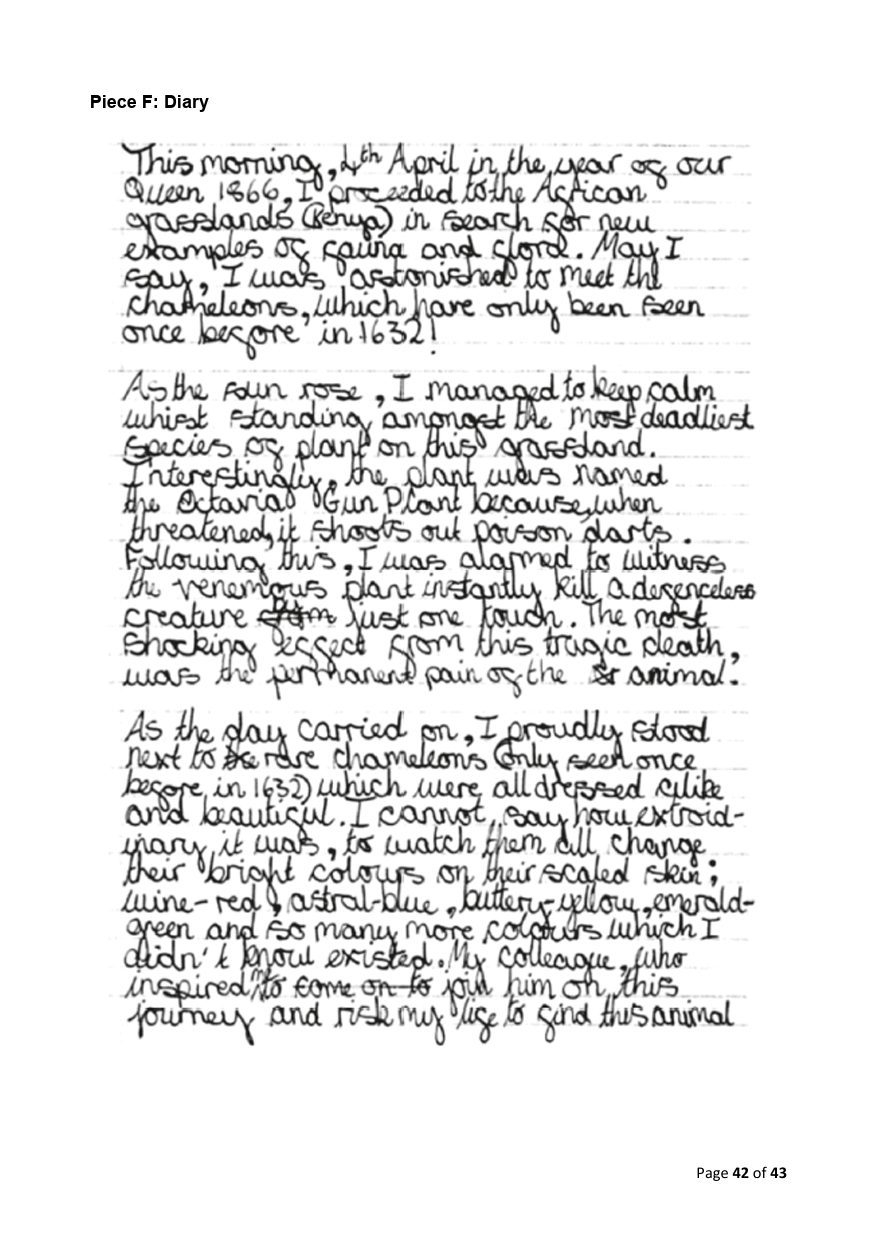
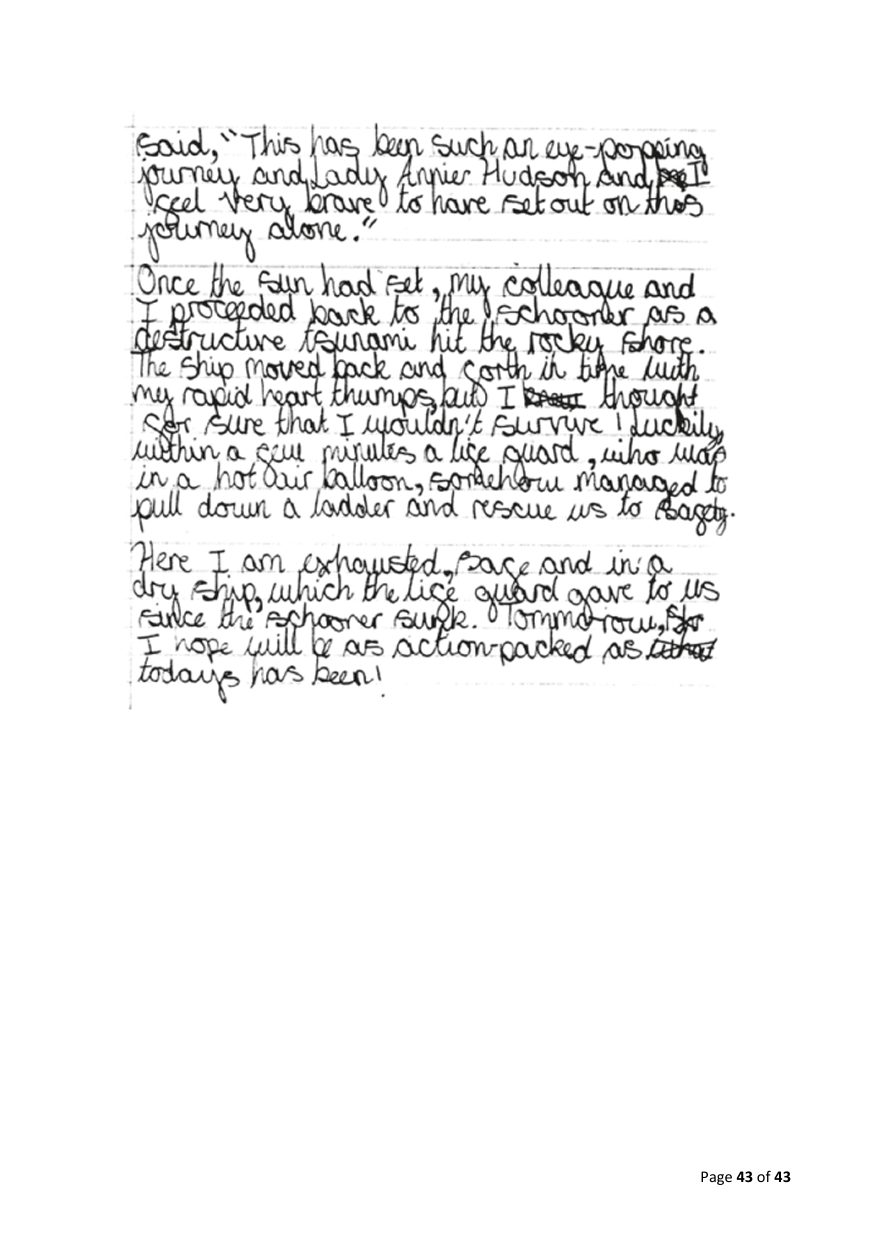
Live marked report
Working at the expected standard
You have written a lively and imaginative diary entry with a strong sense of time, place and adventure. Your writing is effective because it keeps the reader involved and uses exciting language to build atmosphere.
Strengths
You use the first person successfully for a diary voice: "I proceeded to the African grasslands" and "my colleague and I proceeded back to the schooner".
You choose ambitious and vivid vocabulary, including "fauna and flora", "venomous plant", "extraord-inary", "wine-red, astral-blue" and "destructive tsunami".
Your writing follows the sequence of the day clearly, so the reader can track what happens from morning to night.
Areas for Development
Some sentences are awkward or unfinished, such as "My colleague, who inspired to come on to join him on this journey, and me!".
A few punctuation choices are uneven, so the piece would be even clearer with careful checking of commas, full stops and speech punctuation.
Some phrases need a final proofread to make the meaning precise, especially where the wording becomes less clear near the end of the piece.
Next Steps
After drafting, reread the diary aloud and check every sentence for clear meaning and correct punctuation.
Composition
| Can-statement | Status | Evidence |
|---|---|---|
| write effectively for a range of purposes and audiences, selecting language that shows good awareness of the reader (e.g. the use of the first person in a diary) | Met | A clear diary voice is sustained: "This morning, 4th April... I proceeded..." and "I feel very brave". |
| use a range of devices to build cohesion (e.g. conjunctions, adverbials of time and place, pronouns, synonyms) within and across paragraphs | Met | The sequence is easy to follow with "This morning", "As the sun rose", "Following this", "As the day carried on", "Once the sun had set" and "Tomorrow". |
| use verb tenses consistently and correctly throughout their writing | Partially met | Mostly past tense is maintained, but there are awkward or uncertain constructions such as "Tomorrow, I hope will be as action-packed as...". |
Vocabulary
| Can-statement | Status | Evidence |
|---|---|---|
| in narratives, describe settings, characters and atmosphere | Met | The setting and atmosphere are vivid, for example "African grasslands (Kenya)", "the most deadliest species of plant" and "a destructive tsunami". |
| select vocabulary and grammatical structures that reflect what the writing requires, doing this mostly appropriately | Met | The piece includes ambitious choices such as "fauna and flora", "venomous plant", "defenceless creature" and "wine-red, astral-blue, buttery-yellow, emerald-green". |
grammar and punctuation
| Can-statement | Status | Evidence |
|---|---|---|
| use the range of punctuation taught at key stage 2 mostly correctly | Partially met | There is some secure use of commas, inverted commas and brackets, but punctuation is not always controlled, especially in longer sentences. |
| use capital letters, full stops, question marks, commas for lists and apostrophes for contraction mostly correctly | Partially met | Capital letters and commas are often used appropriately, but there are several sentence control issues and the transcript shows some uncertain punctuation near the end. |
| use verb tenses consistently and correctly throughout their writing | Partially met | The main tense is broadly consistent, but there are places where the wording becomes less secure or incomplete, for example "My life is find this animal." |
Spelling
| Can-statement | Status | Evidence |
|---|---|---|
| spell correctly most words from the year 5 / year 6 spelling list, and use a dictionary to check the spelling of uncommon or more ambitious vocabulary | Partially met | Many ambitious spellings are successful in context, including "fauna", "flora", "chameleons", "venomous", "destructive" and "tsunami". |
Handwriting
| Can-statement | Status | Evidence |
|---|---|---|
| Handwriting (assessed from the original work) | Met | Joined cursive writing with variable letter size and occasional overwriting.; Cursive writing is generally readable but has uneven letter size, spacing, and several heavily crossed-out sections. |
Grammar, Punctuation & Spelling security assessment
Sentence structure
“As the sun rose, I managed to keep calm whilst standing amongst the most deadliest species of plant on this grassland.”
“Once the sun had set, my colleague and I proceeded back to the schooner as a destructive tsunami hit the [ILLEGIBLE] shore.”
Fronted adverbials and subordinate clauses are used to move events on.
Punctuation
“This morning, 4th April in the year of our Queen 1866, I proceeded to the African grasslands (Kenya) in search for new examples of fauna and flora.”
“This has been such an eye-popping journey and lady Annie Hudson and [crossed out: [ILLEGIBLE]] I feel very brave to have set out on this journey alone.”
The writing attempts a range of punctuation, including commas, brackets and speech punctuation.
Vocabulary
“fauna and flora”
“venomous plant instantly kill a defenceless creature”
“wine-red, astral-blue, buttery-yellow, emerald-green”
“a destructive tsunami”
Vocabulary is vivid, specific and well matched to the adventurous diary topic.
Cohesion
“This morning”
“Following this”
“As the day carried on”
“Once the sun had set”
“Tomorrow”
Time markers give the piece a clear sequence across the day.
Spelling
“chameleons”
“venomous”
“extraord-inary”
“tsunami”
“schooner”
Many ambitious and less common words are handled successfully in the transcript.
The original writing, exactly as written, with the teacher notes marked
Piece F: Diary
This morning, 4th April in the year of our Queen 1866, I proceeded to the African grasslands (Kenya) in search for new examples of fauna and flora Teacher note: Your topic-specific vocabulary makes the expedition sound convincing.. May I say, I certainly never had to meet the chameleons, which have only been seen once before, in 1632!
As the sun rose Teacher note: This time opener clearly moves your diary on., I managed to keep calm whilst standing amongst the most deadliest Teacher note: Choose either ‘deadliest’ or ‘most deadly’, not both. species of plant on this grassland. Interestingly, the plant was named the Teacher note: ILLEGIBLE sun plant because, when threatened, it shoots out poison darts. Following this Teacher note: This linking phrase helps the reader follow events., I was alarmed to witness the venomous plant instantly kill a defenceless creature Crossed out: from just one touch. The most shocking effect from this tragic death, Teacher note: Remove this comma so the sentence reads smoothly. was the permanent pain of the Crossed out: ? animal.
As the day carried on Teacher note: You continue the events in a clear time sequence., I proudly stood next to some chameleons (only seen once before, in 1632) which were all dressed alike and beautiful. I cannot say how extraord-inary Teacher note: Your ambitious word choice conveys your sense of wonder. it was, to watch them all change their bright colours on their scaled skin; wine-red, astral-blue, buttery-yellow, emerald-green Teacher note: These precise colour choices create a vivid image. and so many more colours which I didn't know existed. My colleague, who inspired to come on to join him on this journey, and me! Teacher note: Rewrite this as a complete sentence so your meaning is clear. My life is find this animal. Teacher note: Proofread this sentence: choose a verb form that makes sense.
said, "This has been such an eye-popping journey Teacher note: This vivid phrase suits your excited diary voice. and lady Annie Hudson and Crossed out: [ILLEGIBLE] I feel very brave to have set out on this journey alone."
Once the sun had set Teacher note: This time phrase clearly signals the final part of the day., my colleague and I proceeded back to the schooner as a destructive tsunami Teacher note: Your powerful vocabulary builds danger and atmosphere. hit the Teacher note: ILLEGIBLE shore. The ship moved back and forth in time with my rapid heart thumps, but I Crossed out: [ILLEGIBLE] thought for sure that I wouldn't survive! Luckily within a few minutes a life guard, who was in a hot air balloon, somehow managed to pull down a ladder and rescue us to safety.
Here I am exhausted, safe and in a dry ship, which the life guard gave to us since the schooner sunk. Tomorrow, I hope will be as action-packed as Crossed out: [ILLEGIBLE] today's has been.
The improved version — read it straight through, then see what changed
Piece F: Diary
This morning, 4th April in the year of our Queen 1866, I proceeded to the African grasslands (Kenya) in search new examples of fauna and flora. only been seen once before, in 1632!
As the sun rose, I managed to keep calm whilst standing . Interestingly, Following this, I was alarmed to witness the venomous plant instantly kill a defenceless creature the animal.
As the day carried on, I proudly stood next to some chameleons, only seen once before in 1632, which were all dressed alike and beautiful. I cannot say how know existed. My colleague find this animal.
I feel very brave to have set out on this journey alone."
Once the sun had set, my colleague and I proceeded back to the schooner as a destructive tsunami hit the shore. The ship moved back and forth in time with my rapid
Here I am: exhausted, safe and in a dry ship, which the has been.
What changed and why
Mark your own piece of writing
Photograph a handwritten piece and get the same report — free to start, no card required.