STA 2018 KS2 Expected Standard
Piece D — Diary
Year 6 · STA Expected Standard · Leigh
Published exemplification — the same live marking as the product, on government or exam-board material, not a pupil’s book. STA KS2 English writing exemplification. Contains material developed by the Standards and Testing Agency for 2018 national curriculum assessments and licenced under Open Government Licence v3.0.
Published script
Live marked report
Working at the expected standard
This is an engaging information piece that gives the reader lots of facts about theatres in a clear, organised way. You make good use of headings and subheadings, so the information is easy to follow, and your writing sounds interested in the topic throughout.
Strengths
You use structure well, with sections such as 'The poor', 'The Rich and Wealthy', 'Building and design' and 'Amazing but True'.
You choose informative and lively words like 'Interestingly', 'Surprisingly', 'Additionally' and 'perfect acoustics'.
You include simple reader-supporting devices such as bullet points and bold-like topic headings to break up the information.
Areas for Development
Some spellings of less common words need checking, such as 'Elizabethian' and 'up-set'.
A few sentences are awkwardly phrased, so the meaning is not always as smooth as it could be.
You could add a little more precision with punctuation, especially in longer sentences, to make the meaning even clearer.
Next Steps
Read each paragraph aloud and edit any sentence that sounds clumsy or unclear.
Proofread for spelling, especially topic words and ambitious vocabulary.
Try varying sentence openings a little more so the writing sounds even more controlled.
Composition
| Can-statement | Status | Evidence |
|---|---|---|
| write effectively for a range of purposes and audiences, selecting language that shows good awareness of the reader | Met | The title 'All about Theatres' and direct address such as 'Did you know' help engage the reader. |
| use paragraphs to organise ideas | Met | Ideas are separated into clear sections, for example 'Seating and Audience' and 'Building and design'. |
| in non-narrative writing, use simple devices to structure the writing and support the reader (e.g. headings, sub-headings, bullet points) | Met | The piece uses headings, sub-headings and bullets in 'Amazing but True:' to guide the reader. |
Vocabulary
| Can-statement | Status | Evidence |
|---|---|---|
| select vocabulary and grammatical structures that reflect what the writing requires, doing this mostly appropriately | Met | The writing generally keeps an informative tone, with words such as 'Interestingly', 'Surprisingly', 'Additionally' and 'acoustics'. |
| exercise an assured and conscious control over levels of formality, particularly through manipulating grammar and vocabulary to achieve this | Partially met | The register is usually informative, but some phrases are awkward or uneven, for example 'one performance of the Globe Theatre' and 'leaps to catch a glimpse'. |
Grammar and punctuation
| Can-statement | Status | Evidence |
|---|---|---|
| use capital letters, full stops, commas for lists and apostrophes for contraction mostly correctly | Partially met | Capital letters and full stops are generally secure, and commas are often used to separate clauses and items, as in 'However, men were thought to be more important than ladies'. |
| use a range of devices to build cohesion (e.g. conjunctions, adverbials of time and place, pronouns, synonyms) within and across paragraphs | Met | Cohesion is supported by linking words such as 'However', 'Interestingly', 'Additionally', 'Unlike' and 'Although'. |
| use verb tenses consistently and correctly throughout their writing | Partially met | The piece is mainly in an informative present/past style, but there are occasional shifts, such as 'was opened' and 'still want' in the same section. |
Spelling
| Can-statement | Status | Evidence |
|---|---|---|
| spell correctly most words from the year 3 / year 4 spelling list, and some words from the year 5 / year 6 spelling list | Partially met | Many common and topic words are correct, such as 'audience', 'performance' and 'acoustics', but there are also notable errors such as 'Elizabethian' and 'up-set'. |
| spell correctly most words from the year 5 / year 6 spelling list, and use a dictionary to check the spelling of uncommon or more ambitious vocabulary | Not met | Some ambitious spellings are accurate, but the piece does not show consistent secure control of Year 5/6 spellings across the whole response. |
| Can-statement | Status | Evidence |
|---|
| Can-statement | Status | Evidence |
|---|
| Can-statement | Status | Evidence |
|---|
| Can-statement | Status | Evidence |
|---|
| Can-statement | Status | Evidence |
|---|
| Can-statement | Status | Evidence |
|---|
| Can-statement | Status | Evidence |
|---|
Handwriting
| Can-statement | Status | Evidence |
|---|---|---|
| Handwriting (assessed from the original work) | Met | Joined cursive writing is generally readable but crowded, with uneven letter size and spacing.; Cursive writing is generally readable but densely spaced with uneven letter sizes and several overwrites.; Joined cursive script is densely written with variable sizing and crowded spacing.; Cursive writing is generally readable but has variable letter size and crowded spacing. |
The original writing, exactly as written, with the teacher notes marked
Piece D: Information
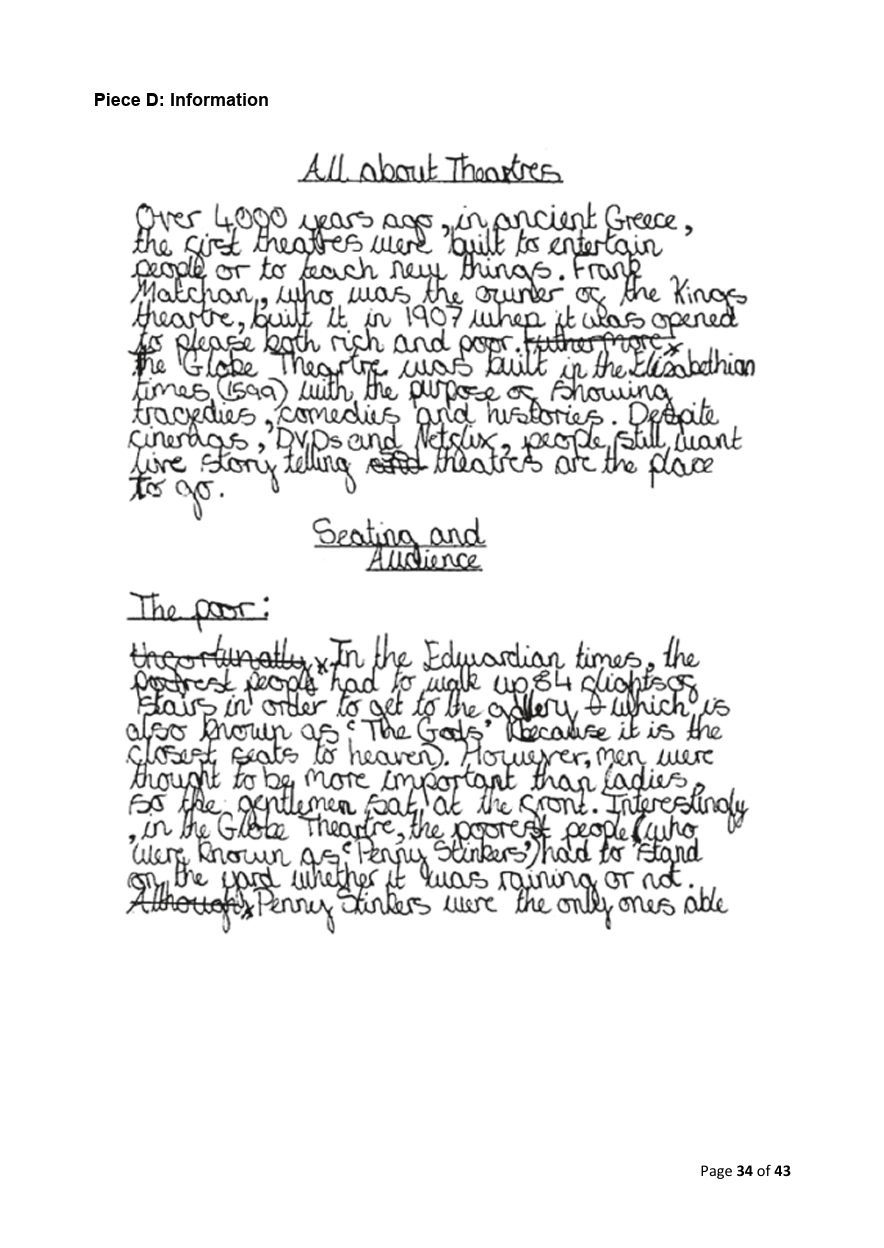
All about Theatres
Over 4000 years ago in ancient Greece, the first theatres were built to entertain people or to teach new things. Frank Matcham, who was the owner of the Kings Theatre, built it in 1907 when it was opened to the public with one performance of the Globe Theatre. This was built in the Elizabethian Teacher note: Check this less common historical word in a dictionary. times (1599) with the purpose of showing tragedies, comedies and histories. Despite cinemas, TVs and Netflix, people still want live story telling and the theatres are the place to go.
Seating and Audience Teacher note: Your clear sub-heading helps the reader find this section.
The poor: Teacher note: This topic heading clearly introduces information about poorer audience members.
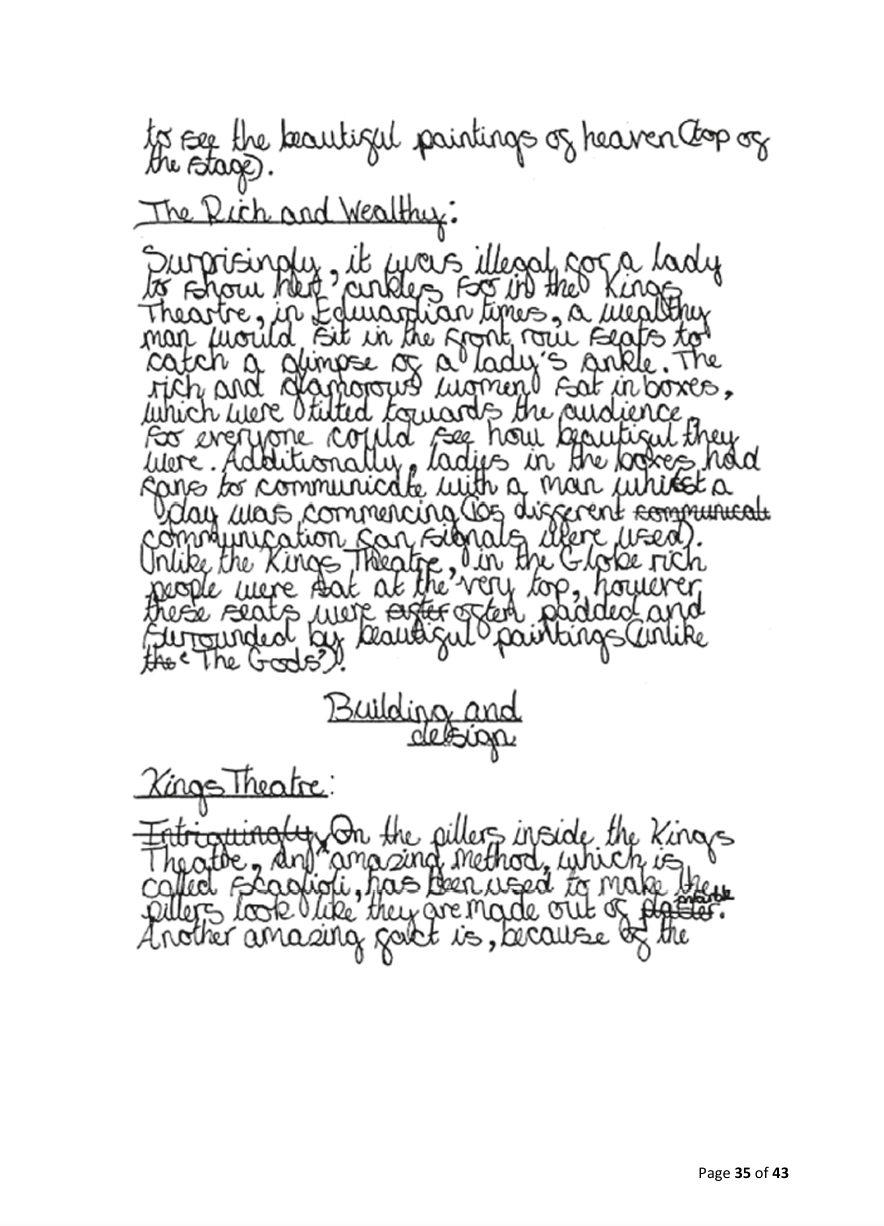
Crossed out: Unfortunately, In the Edwardian times, the poorest people had to walk up 84 flights of stairs in order to get to the gallery, which is also known as ‘the gods’ because it is the closest seats to heaven. However, Teacher note: This connective helps link contrasting ideas clearly. men were thought to be more important than ladies so the gentlemen sat at the front. Interestingly, Teacher note: This adverbial draws attention to an engaging historical detail. in the Globe Theatre, the poorest people (who were known as ‘penny stinkers’) had to stand on the yard whether it was raining or not. Crossed out: Although penny stinkers were the only ones able to see the beautiful paintings of heaven (top of the stage).
The Rich and Wealthy:
Surprisingly, it was illegal for a lady to show her ankles so in the Kings Theatre, in Elizabethan times, a wealthy man would sit in the front row, leaps Teacher note: Keep the verb tense consistent: use ‘leap’ after ‘would’. to catch a glimpse of a lady’s ankle. The rich and glamorous women sat in boxes, which were tilted towards the audience so everyone could see how beautiful they were. Additionally, Teacher note: This adverbial adds another point and creates cohesion. ladies in the boxes had fans to communicate with a man whilst a play was commencing as different Crossed out: communication showed function, fan signals were used. Teacher note: Reword this sentence so the explanation of fan signals is clearer. Unlike, the Kings Theatre, in the Globe rich people were sat at the very top, however these seats were Crossed out: often padded and surrounded by beautiful paintings (unlike the ‘the gods’).
Building and design Teacher note: This sub-heading organises your information into a new topic.
Kings Theatre:
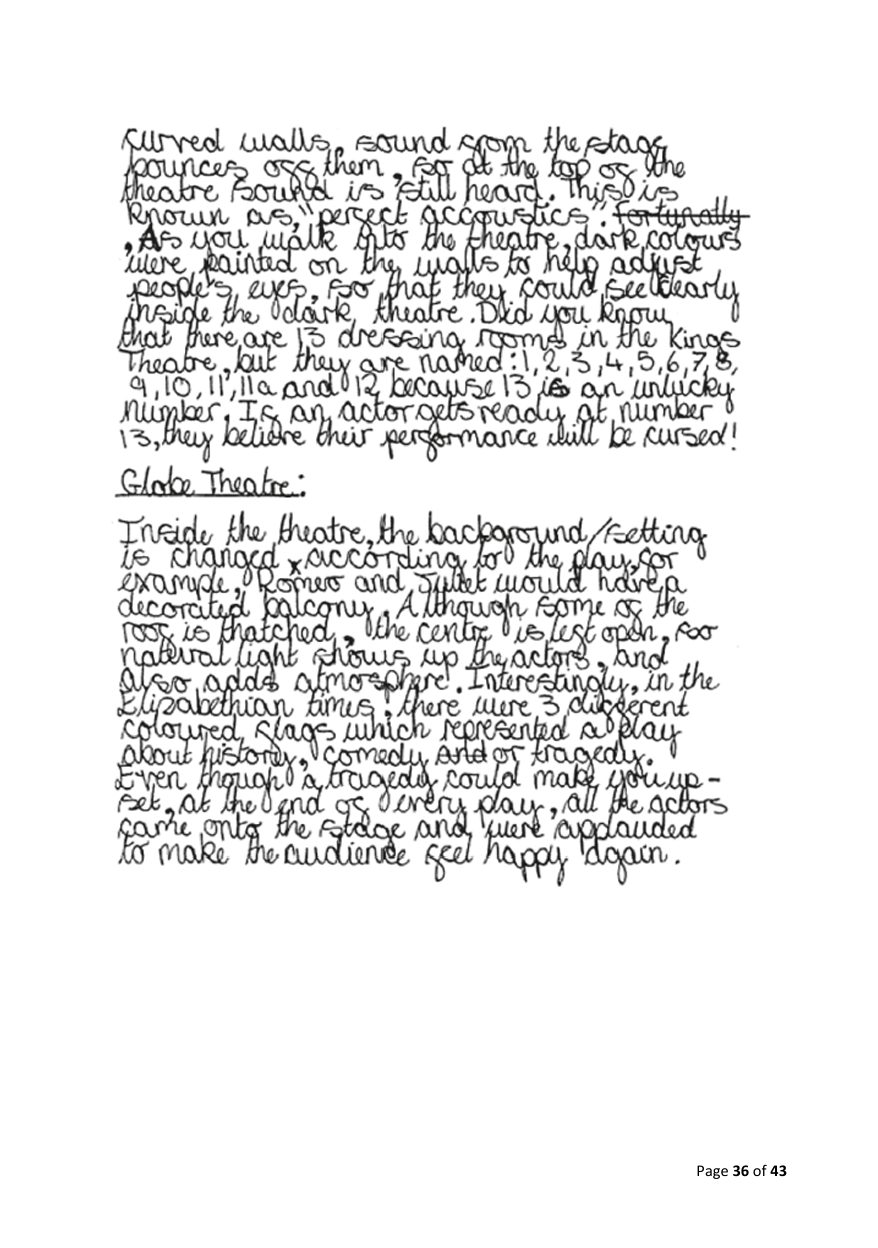
Crossed out: Intriguingly On the pillars inside the Kings Theatre, an amazing method, which is called Teacher note: ILLEGIBLE method, has been made. pillars look like they are made out of Crossed out: paper. Another amazing fact is, because of the curved walls, sound from the stage bounces off them, so at the top of the theatre sound is still heard. This is known as perfect acoustics. Teacher note: Precise subject vocabulary makes the explanation informative. Thankfully
As you walk into the theatre, dark colours were painted Teacher note: Match the verb tense: ‘walk’ needs ‘are painted’, or change both to past tense. on the walls to help adjust people's eyes, so that they could see clearly inside the dark theatre. Did you know that there is 13 dressing rooms in the kings theatre, but they are named 1,2,3,4,5,6,7,8,9,10,11,11a and 12 because 13 is an unlucky number. If an actor gets ready in number 13, they believe their performance will be cursed!
Globe Theatre:
Inside the theatre, the background/setting is changed according to the plays, for example, Romeo and Juliet would have a decorated balcony. Although some of the parts changed, the centre, left and far right stayed up the actors and also adds atmosphere. Interestingly, in the Elizabethian Teacher note: Check the spelling of this Year 5/6 historical word. times, there were 3 different coloured flags which represented a play about history, comedy and/or tragedy. Even though a tragedy could make you up-set Teacher note: This word should be written as one word: ‘upset’., at the end of every play, all the actors came onto the stage and were applauded to make the audience feel happy again.
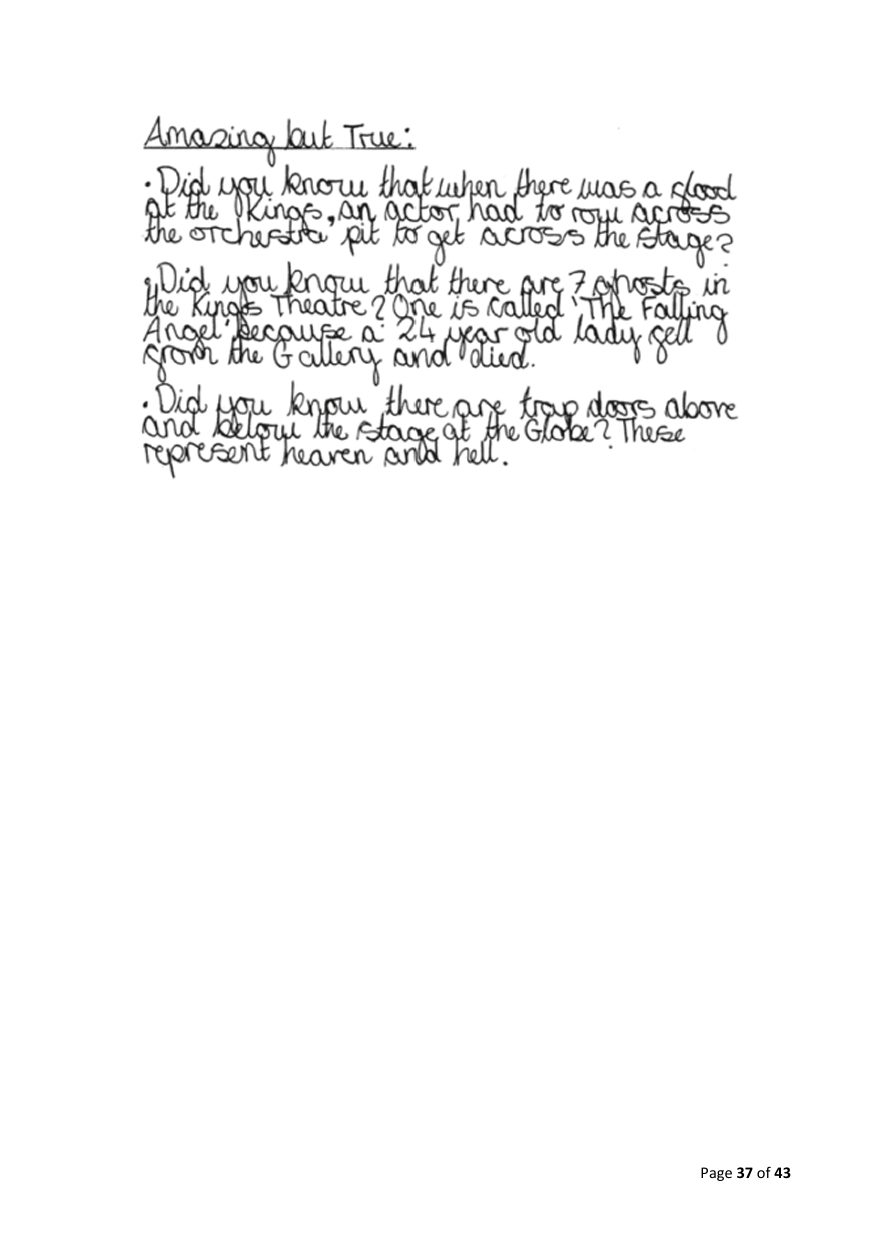
Amazing but True: Teacher note: This lively heading suits your interesting-facts section.
• Did you know, that when there was a crowd at the Kings, they had to put actors in the orchestra pit to get across the stage? Teacher note: Your bullet-point question engages the reader with a surprising fact.
• Did you know that there are 7 ghosts in the kings theatre? One is called "The crying Angel because a 24 year old lady fell from the Gallery and died.
• Did you know there are trap doors above and below the stage at the Globe? These represent heaven and hell.
The improved version — read it straight through, then see what changed
# All About Theatres
**History and Audience:** Over new things. Frank Matcham, who owned the King’s Theatre, built it in 1907, when it opened to the public with one performance by the Globe Theatre. tragedies, comedies and histories. Despite cinemas, TVs and Netflix, people still want live storytelling, and theatres are the place to go.
In Edwardian times, the poorest people had to walk up 84 flights of stairs to reach the gallery, the closest seats to heaven. However, men were thought to be more important than ladies, so gentlemen sat at the front. Interestingly, at the Globe Theatre, the poorest people, known as ‘penny stinkers’, had to stand in the yard whether it was raining or not. They were the only audience members able to see the beautiful paintings of heaven at the top of the stage. Surprisingly, in Elizabethan times, it was illegal for a lady to show her ankles; therefore, at the King’s Theatre, a wealthy man would sit in the front row, Rich and glamorous women sat in boxes tilted towards the audience so that everyone could see how beautiful they were. Additionally, ladies in the boxes Unlike at the King’s Theatre, rich people at the Globe sat at the very top; however, these seats were padded and surrounded by beautiful paintings, unlike ‘the gods’.
**Building and Design:** Because of the curved walls, sound from the stage bounces off them, so it can still be heard at the top of the theatre. This is known as perfect acoustics. As you walk into the theatre, dark colours have been painted on the walls to help people’s eyes adjust so that they can see clearly inside. Did you know that there and 12 because 13 is an unlucky number. If an actor gets ready in room 13, they believe their performance will be cursed!
At the Globe Theatre, the background and setting are changed according to the play; for example, *Romeo and Juliet* would have a decorated balcony. Although some atmosphere. Interestingly, in , all the actors came onto the stage at the end of every play and were applauded to make the audience feel happy again.
**Amazing but True:**
- Did you know that, when there was a crowd at the King’s, actors had to be put in the orchestra pit to get across the stage? - Did you know that there are lady fell from the gallery and died. - Did you know that there are trapdoors above and below the stage at the Globe? These represent heaven and hell.
What changed and why
Mark your own piece of writing
Photograph a handwritten piece and get the same report — free to start, no card required.