STA 2018 KS2 Expected Standard
Piece A — Narrative
Year 6 · STA Expected Standard · Leigh
Published exemplification — the same live marking as the product, on government or exam-board material, not a pupil’s book. STA KS2 English writing exemplification. Contains material developed by the Standards and Testing Agency for 2018 national curriculum assessments and licenced under Open Government Licence v3.0.
Published script
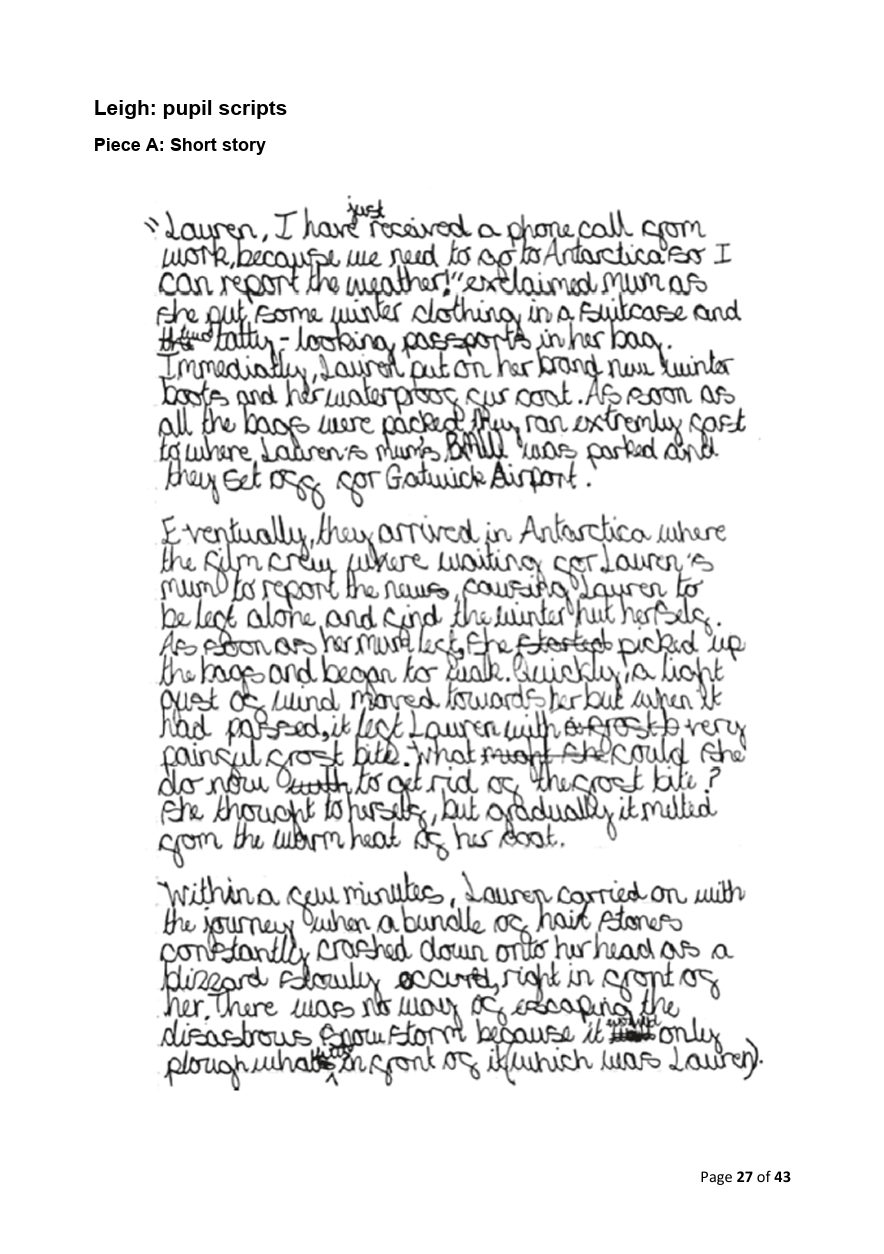
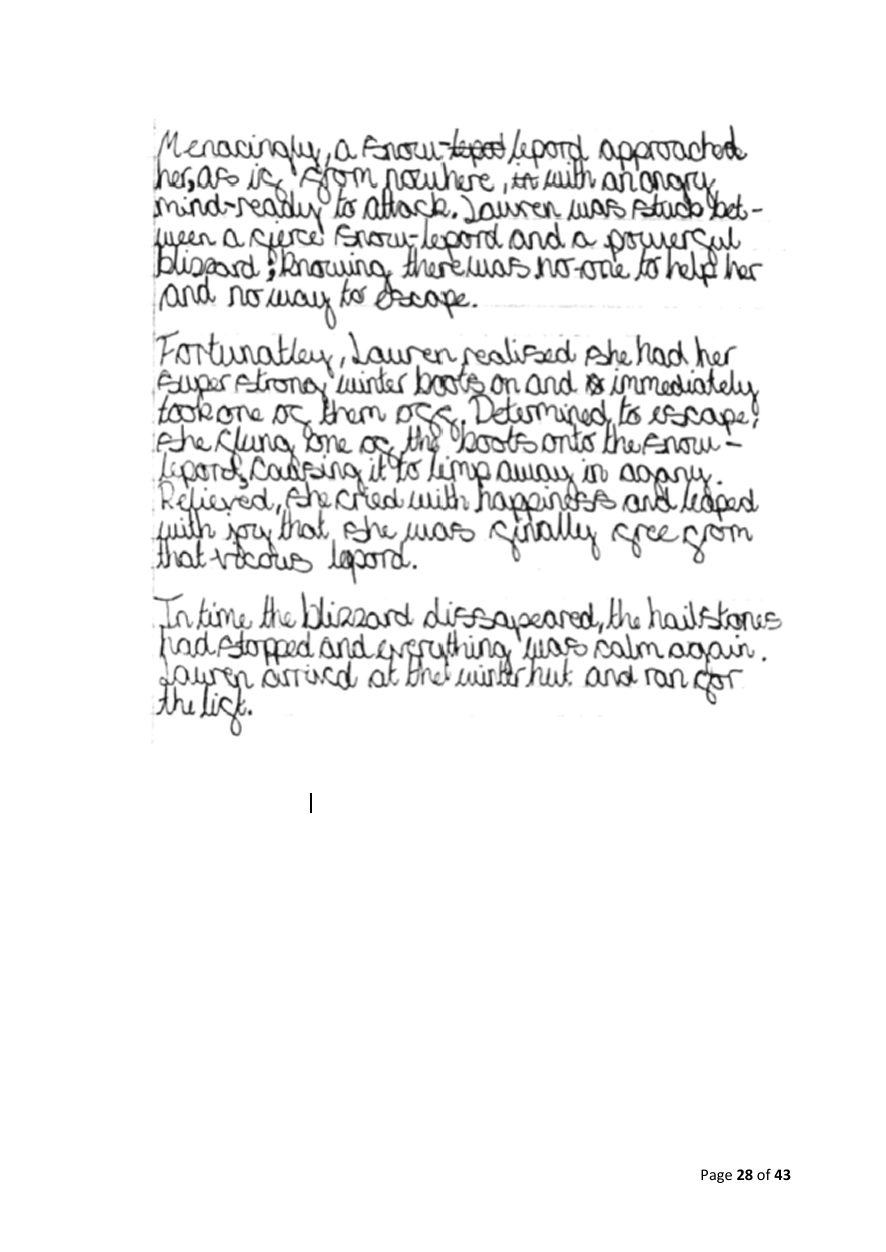
Live marked report
Working at the expected standard
You wrote an engaging adventure story that moves quickly from the announcement at home to the dangers of Antarctica. Your writing keeps the reader interested with strong time connectives and vivid descriptions, and it fits the expected-standard narrative exemplar well. There is some promising control here, but the story does not yet show the more assured register control and advanced punctuation seen in the greater-depth exemplar.
Strengths
You used time adverbials such as “Immediately,” “Eventually,” “Within a few minutes” and “Fortunately” to guide the reader through the events.
You created atmosphere well with phrases like “a very painful snowflake bite,” “fierce snowy leopard” and “disastrous snowstorm.”
Your opening dialogue gives the story a dramatic start and quickly sets up the journey.
Areas for Development
Some verb forms need tightening, for example “is immediately took” does not keep the tense controlled.
A few punctuation choices need careful checking, especially in the sentence about the snowstorm and in the direct speech.
Some spellings of ambitious words need more checking, such as “occured” and “dissapeared.”
Next Steps
Re-read your story once just for tense and punctuation, checking that each sentence is in the same tense and ends clearly.
Practise writing one short adventure paragraph using two fronted adverbials and one piece of direct speech, then proofread it for spelling.
Composition
| Can-statement | Status | Evidence |
|---|---|---|
| write effectively for a range of purposes and audiences, selecting language that shows good awareness of the reader | Met | The story is engaging and purposeful, with a clear opening and rising action: “Lauren, I have received a phone call from work...” |
| in narratives, describe settings, characters and atmosphere | Met | The setting and danger are developed well through “in Antarctica,” “blizzard storm,” “menacingly” and “vicious leopard.” |
| integrate dialogue in narratives to convey character and advance the action | Partially met | Dialogue appears at the start and moves the story on, but it is limited in amount and characterisation is not developed through conversation. |
| use a range of devices to build cohesion within and across paragraphs | Met | The writing is linked by time connectives and pronouns such as “Immediately,” “Eventually,” “As soon as,” “Within a few minutes,” and “Fortunately.” |
Vocabulary
| Can-statement | Status | Evidence |
|---|---|---|
| select vocabulary and grammatical structures that reflect what the writing requires, doing this mostly appropriately | Met | Word choice suits an adventure story, with phrases such as “waterproof fur coat,” “super strong winter boots,” “determined” and “disastrous snowstorm.” |
| distinguish between the language of speech and writing and choose the appropriate register | Partially met | The narration is mostly suitably formal, but there is not yet clear, sustained control of register across the whole piece. |
Grammar and punctuation
| Can-statement | Status | Evidence |
|---|---|---|
| use capital letters, full stops, question marks, commas for lists and apostrophes for contraction mostly correctly | Met | Capital letters and apostrophes are generally secure, for example “Lauren’s mum’s BMW” and “Lauren’s passport.” |
| use verb tenses consistently and correctly throughout their writing | Partially met | The piece is mainly in the past tense, but there are slips such as “is immediately took”. |
| use the range of punctuation taught at key stage 2 mostly correctly | Partially met | Speech punctuation is attempted and mostly clear, but there are some inaccuracies in sentence punctuation and grouping. |
Spelling
| Can-statement | Status | Evidence |
|---|---|---|
| spell correctly most words from the year 5 / year 6 spelling list | Met | Many ambitious words are correct, including “eventually,” “fortunately,” “menacingly,” “determined” and “disastrous.” |
| use a dictionary to check the spelling of uncommon or more ambitious vocabulary | Not met | There is no evidence of independent checking, and some ambitious spellings are inaccurate, such as “occured” and “dissapeared.” |
Handwriting
| Can-statement | Status | Evidence |
|---|---|---|
| Handwriting (assessed from the original work) | Met | Cursive writing is densely formed with variable spacing and occasional overwritten words.; Joined cursive writing is generally readable, with variable size and crowded spacing. |
Grammar, Punctuation & Spelling security assessment
Sentence structure
“Immediately, Lauren put on her brand new winter boots and her waterproof fur coat.”
“As soon as all the bags were packed they ran extremely fast to where Lauren’s mum’s BMW was parked and they set off for Gatwick Airport.”
“Within a few minutes, Lauren carried on with the journey...”
The writing uses several time-led openings to sequence events clearly.
Punctuation
““Lauren, I have received a phone call from work, because we need to go to Antarctica so I can report the weather!””
““what now? What could she do now ... to get rid of the frost bite?””
Dialogue is clearly marked, though there are a few punctuation and capitalisation slips within speech.
“Lauren’s mum’s BMW”
“Lauren’s passport”
Possessive apostrophes are used correctly.
Grammar
“they arrived in Antarctica”
“Lauren realised she had her super strong winter boots on”
“she flung one of the boots onto the snow-leopard”
“the hailstones had stopped”
The narrative is mainly in the past tense with a few slips.
Spelling
“Eventually”
“menacingly”
“Fortunately”
“disastrous”
“occured”
“dissapeared”
Most ambitious vocabulary is spelled correctly, with a few errors in less familiar words.
Vocabulary
“a very painful snowflake bite”
“a fierce snowy leopard”
“that vicious leopard”
The word choice creates atmosphere and supports the adventure narrative.
The original writing, exactly as written, with the teacher notes marked
“Lauren, I have received a phone call from work, because we need to go to Antarctica so I can report the weather!” Teacher note: Your opening dialogue creates urgency and begins the action. exclaimed mum as she put some winter clothing in a suitcase and threw Lauren’s passport in her bag. Immediately, Teacher note: This fronted adverbial clearly guides the reader through events. Lauren put on her brand new winter boots and her waterproof fur coat. As soon as all the bags were packed they ran extremely fast to where Lauren’s mum’s BMW was parked and they set off for Gatwick Airport.
Eventually, they arrived in Antarctica where the film crew were waiting for Lauren’s mum to report the news, causing Lauren to be left alone and find the winter hut herself. As soon as her mum left, she Crossed out: started packed up the bags and began to walk. Quickly, a light gust of wind moved towards her but when it had passed, Lauren felt a very painful snowflake bite. Teacher note: This vivid phrase helps the reader feel Lauren’s discomfort. “what now? Teacher note: Start spoken questions with a capital letter. What could she do now Teacher note: ILLEGIBLE to get rid of the frost bite?” She thought to herself, but gradually it melted from the warm heat of her coat.
Within a few minutes, Lauren carried on with the journey when a bundle of white stones constantly crashed down onto her head as a blizzard storm occured, right in front of her, There was no way of escaping the disastrous snowstorm because it Crossed out: was only ploughing in front of it(which was Lauren).
Menacingly, Teacher note: This fronted adverbial builds suspense before the attack. a Crossed out: [ILLEGIBLE] leopard approached her as if from nowhere, its with an angry mind ready to attack. Lauren was stuck bet- ween a fierce snowy leopard Teacher note: Your precise description makes the danger clear. and a powerful blizzard, knowing there was no-one to help her and no way to escape.
Fortunately, Teacher note: This time adverbial signals a change in the action. Lauren realised she had her super strong winter boots on and is immediately took Teacher note: Keep the past tense: use ‘immediately took’. one of them off. Determined to escape, she flung one of the boots onto the snow- leopard, causing it to jump away in agony. Relieved, she cried with happiness and filled with joy that she was finally free from that vicious leopard.
In time the blizzard dissapeared, Teacher note: Check this ambitious word in a dictionary: ‘disappeared’. the hailstones had stopped and everything was calm again. Lauren arrived at the winter hut and ran for her life.
The improved version — read it straight through, then see what changed
“Lauren, I have received a phone call from work because we need to go to Antarctica so I can report the weather!” as she put winter clothing into a suitcase and threw Lauren’s passport into her bag. Immediately, Lauren put on her waterproof fur coat. As soon as all the bags were packed, they ran set off for Gatwick Airport.
Eventually, they arrived in Antarctica, where the film crew were waiting for Lauren’s mum to report the news, . As soon as her mum left, Lauren packed the bags and began to walk. A light gust of wind moved towards her; when it had passed, Lauren felt a very painful snowflake bite. “What now? What could she do of her coat. Within a few minutes, Lauren carried on with her journey when Menacingly, a with an angry mind ready to attack. Lauren was to help her and no way to escape. Fortunately, Lauren realised that she had her off. Determined to escape, she flung it at the snow leopard, causing it to jump away in agony. Relieved, Lauren cried with happiness, filled with joy that she was finally free from that vicious leopard. In time, the blizzard stopped and everything was calm again. Lauren arrived at the winter hut and ran for her life.
What changed and why
Mark your own piece of writing
Photograph a handwritten piece and get the same report — free to start, no card required.