STA 2018 KS2 Expected Standard
Piece E — Instructions
Year 6 · STA Expected Standard · Leigh
Published exemplification — the same live marking as the product, on government or exam-board material, not a pupil’s book. STA KS2 English writing exemplification. Contains material developed by the Standards and Testing Agency for 2018 national curriculum assessments and licenced under Open Government Licence v3.0.
Published script
Live marked report
Working at the expected standard
This is an imaginative and engaging short story with a strong sci-fi setting, a clear storyline and a good sense of drama. It sits comfortably at the expected standard because it uses narrative features such as setting, character, atmosphere, dialogue and cohesion, even though the technical control is not yet strong enough for greater depth.
Strengths
The opening immediately places the reader in a vivid setting: 'In 2621 on the planet Zorda'.
Dialogue helps move the story on and show character, for example 'I’ll take the trade old man' and 'What do you mean, you traded the sword?'
You use effective linking words and phrases such as 'Whilst', 'Within a few minutes', 'Meanwhile' and 'As soon as' to move the action along.
Areas for Development
Check sentence boundaries and speech punctuation so that each sentence is complete and each piece of direct speech is punctuated accurately.
Proofread carefully for tense, agreement and grammar slips, especially in phrases such as 'which, has the only source of income' and 'who she has raised'.
Re-read ambitious spellings and correct the ones that are close but not quite right, such as 'sureptitiously' and 'accidently'.
Next Steps
After drafting, read each paragraph aloud and check that every sentence has the correct punctuation before moving on.
Make a final proofreading pass just for Year 5/6 spellings and fix any words that are almost right but not fully secure.
Composition
| Can-statement | Status | Evidence |
|---|---|---|
| Write effectively for a range of purposes and audiences, selecting language that shows good awareness of the reader. | Partially met | The story is engaging and purposeful, but the control is uneven and some meaning is weakened by inaccurate phrasing. |
| Use paragraphs to organise ideas. | Met | The writing is divided into clear sections across the story, helping the reader follow the action. |
| In narratives, describe settings, characters and atmosphere. | Met | The writer establishes a strong setting and atmosphere through phrases such as 'In 2621 on the planet Zorda' and 'the mysterious and multicoloured hole'. |
| Integrate dialogue in narratives to convey character and advance the action. | Met | Dialogue drives the plot forward in the trading scene and the conflict with Jack's mother. |
Vocabulary
| Can-statement | Status | Evidence |
|---|---|---|
| Select vocabulary and grammatical structures that reflect what the writing requires, doing this mostly appropriately. | Partially met | There is some ambitious vocabulary, such as 'mysterious', 'multicoloured', 'extraordinary' and 'surreptitiously', but it is not always controlled accurately. |
| Use a range of devices to build cohesion within and across paragraphs. | Met | Time and place links such as 'Whilst', 'Within a few minutes', 'Meanwhile', 'Suddenly' and 'As soon as' support the flow of the narrative. |
Grammar and punctuation
| Can-statement | Status | Evidence |
|---|---|---|
| Use verb tenses consistently and correctly throughout their writing. | Partially met | Most of the narrative stays in the past tense, but there are slips such as 'has the only source of income' and 'who she has raised'. |
| Use the range of punctuation taught at key stage 2 mostly correctly. | Partially met | Direct speech is attempted, but punctuation is not consistently secure and sentence demarcation is sometimes unclear. |
| Use capital letters, full stops and commas mostly correctly. | Partially met | Some control is shown, but there are frequent lapses, for example 'The old man was confused also,' and 'Tap! went the stick as it accidently fell to the floor.' |
Spelling
| Can-statement | Status | Evidence |
|---|---|---|
| Spell correctly most words from the year 5 / year 6 spelling list, and use a dictionary to check uncommon or more ambitious vocabulary. | Partially met | Many common spellings are correct and ambitious words are attempted, though there are some errors in challenging words such as 'sureptitiously' and 'accidently'. |
Handwriting
| Can-statement | Status | Evidence |
|---|---|---|
| Handwriting (assessed from the original work) | Met | Joined script is generally readable, with crowded words and several heavily overwritten corrections.; Joined cursive script is generally readable, with crowded lines and uneven letter sizing.; Fast cursive writing with crowded words, variable letter size, and occasional unclear forms.; Large mixed cursive script with variable spacing and some crowded letter shapes. |
Grammar, Punctuation & Spelling security assessment
Sentence structure
“Whilst his mother was busy”
“Within a few minutes he was already at the alley way”
“As soon as the man gave Jack the stick”
A range of sentence openings is used to move events on.
Punctuation
“Yes mother, he agreed and nodded as he said it”
“I’ll take the trade old man, he shouted”
“What do you mean, you traded the sword?”
Inverted commas are attempted, but speech punctuation is not consistently secure.
“Whilst his mother was busy, he heard this”
“Meanwhile, at the tower about a mile away”
“Suddenly, everything was still”
Commas are sometimes used to mark clause boundaries and add pacing.
Vocabulary
“mysterious and multicoloured hole”
“extraordinary shimmering”
“brand-new looking droid”
Vocabulary creates a vivid adventure tone and supports the sci-fi setting.
Grammar
“he agreed”
“he was already at the alley way”
“Jack jumped straight into the portal hole”
The story is mainly in the past tense, with some slips elsewhere.
“which, has the only source of income”
“who she has raised”
“The old man was confused also”
Some grammar and agreement errors are present.
Spelling
“surreptitiously”
“extraordinary”
“mysterious”
Many ambitious spellings are attempted; a few challenge words are not yet secure.
The original writing, exactly as written, with the teacher notes marked
Piece E: Short story
Another dimension
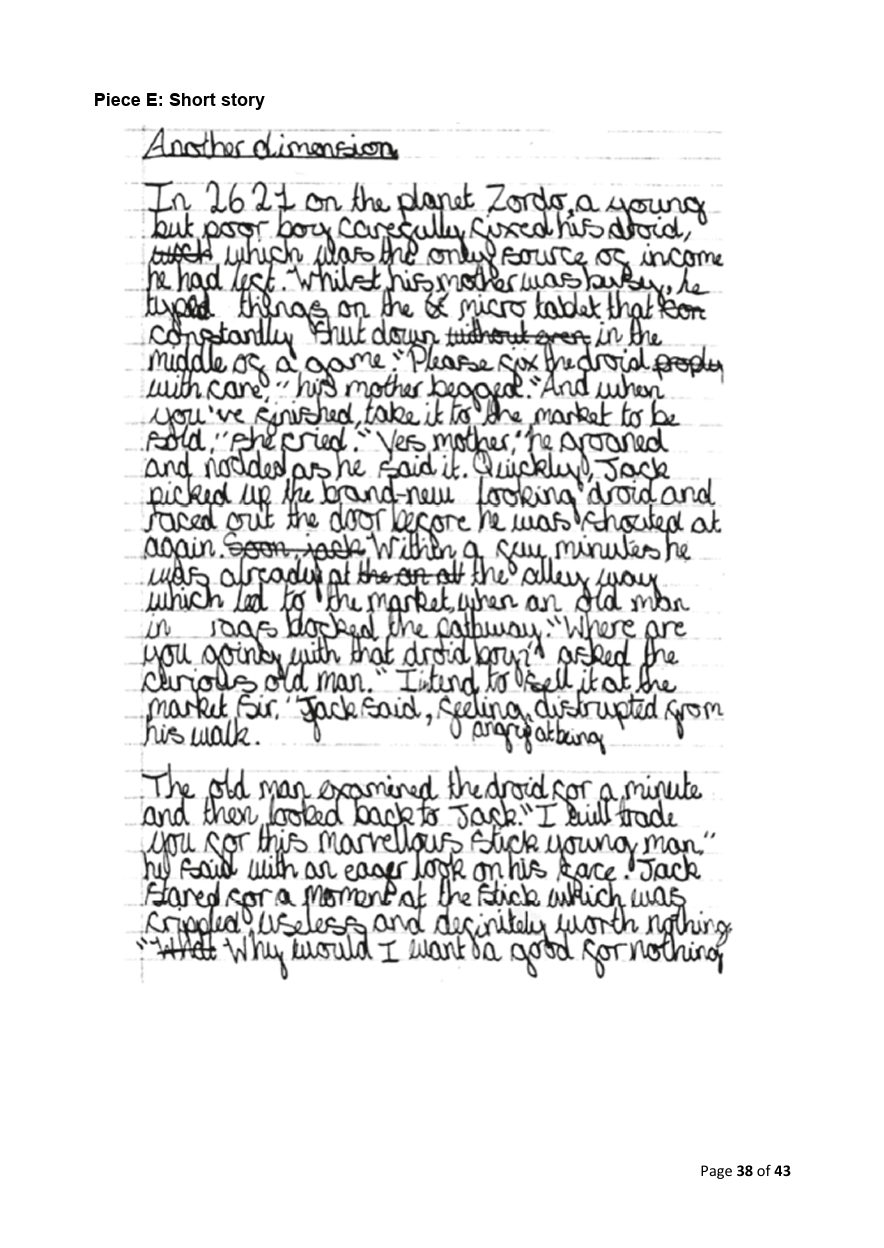
In 2621 on the planet Zorda Teacher note: This opening immediately establishes a vivid futuristic setting., a young but poor boy carefully fixed his droid, Crossed out: which which, has the only source of income Teacher note: Check agreement: the droid 'was' his source of income. he had left. Whilst his mother was busy Teacher note: This fronted subordinate clause helps move the action on., he heard this, "on the Teacher note: ILLEGIBLE label that "born constantly shut down Crossed out: without reason in the middle of a game "Please fix the droid Crossed out: properly with care," his mother begged. "And when you've finished, take it to the market to be sold," she cried. "Yes mother," he agreed and nodded as he said it. Quickly Jack picked up the brand-new looking droid Teacher note: Your precise description helps the reader picture the droid. and raced out the door before he was shouted at again. Crossed out: Soon, yeah Within a few minutes he Teacher note: This time phrase creates cohesion as the journey continues. was already at Crossed out: the town at the alley way, which led to the market, when an old man in ragged clothes came up to him. "Where are you going with that droid boy?" asked the curious old man. "Listen to sell it at the market Sir," Jack said, feeling disrupted from his walk.
The old man examined the droid for a minute and then, looked back to Jack. "I will trade you for this marvellous stick young man," he said with an eager look on his face. Jack stared for a moment at the stick which was Crossed out: completely useless and definitely worth nothing "what? Why would I want so good for nothing" Teacher note: Start the speech with a capital and punctuate its ending.
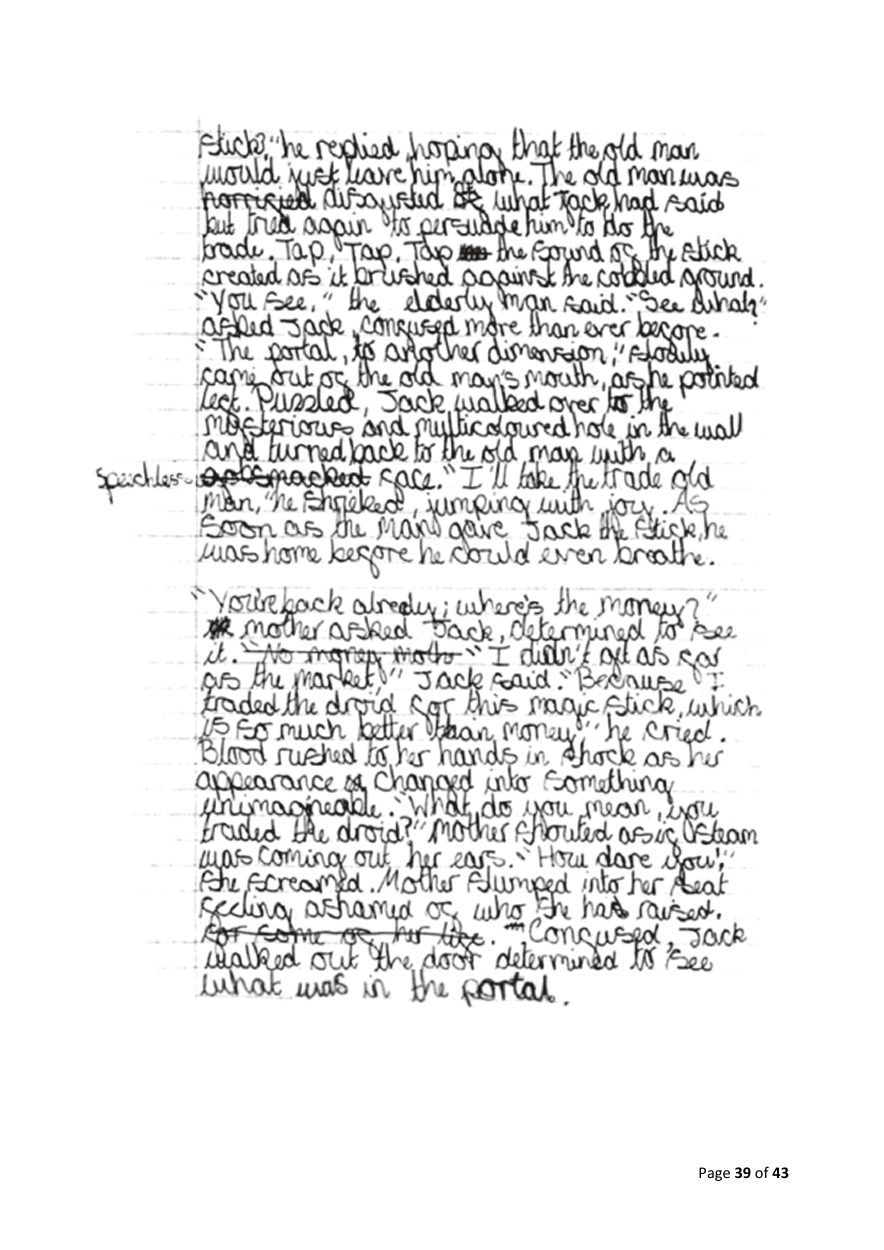
“Jack,” he replied, hoping that the old man would just leave him alone. The old man was confused also, Crossed out: ILLEGIBLE what Jack had said but tried again to persuade him to do the trade. Tap, Tap, Take Crossed out: ILLEGIBLE the sword or the stick created for the dark of games, he added. “You see,” the elderly man said. “See what?” asked Jack confused more than ever before. “The portal to another dimension,” replied, pointing at the old man’s mouth, at the portrait left. Puzzled, Jack walked over to the mysterious and multicoloured hole Teacher note: These imaginative adjectives make the portal intriguing. in the wall and turned back to the old man with a Margin note: speechles Crossed out: shocked face. “I’ll take the trade old man,” Teacher note: Dialogue reveals Jack’s excitement and moves the plot forward. he shouted, jumping in with joy. As soon as the man gave Jack the stick Teacher note: This subordinate clause clearly links the action and its result., he was home before he could even breathe.
“You’re back already, where’s the money?” Mother asked Jack, bemused. “See it. No money mother - I didn’t get as far as the market,” Jack said. “Because I traded the sword for this magic stick, which is so much better than money,” he cried. Blues rushed to her hands in shock as her appearance is changed Teacher note: Keep the tense in the past: use 'changed' rather than 'is changed'. into something unimaginable. “What do you mean, you traded the sword?” Mother shouted as a steam was coming out her ears. “You done fool,” she screamed. Mother jumped into her Teacher note: ILLEGIBLE, feeling ashamed of who she has raised. Crossed out: for some of her life. “Confused, Jack slammed shut the door determined to see what was in the portal.
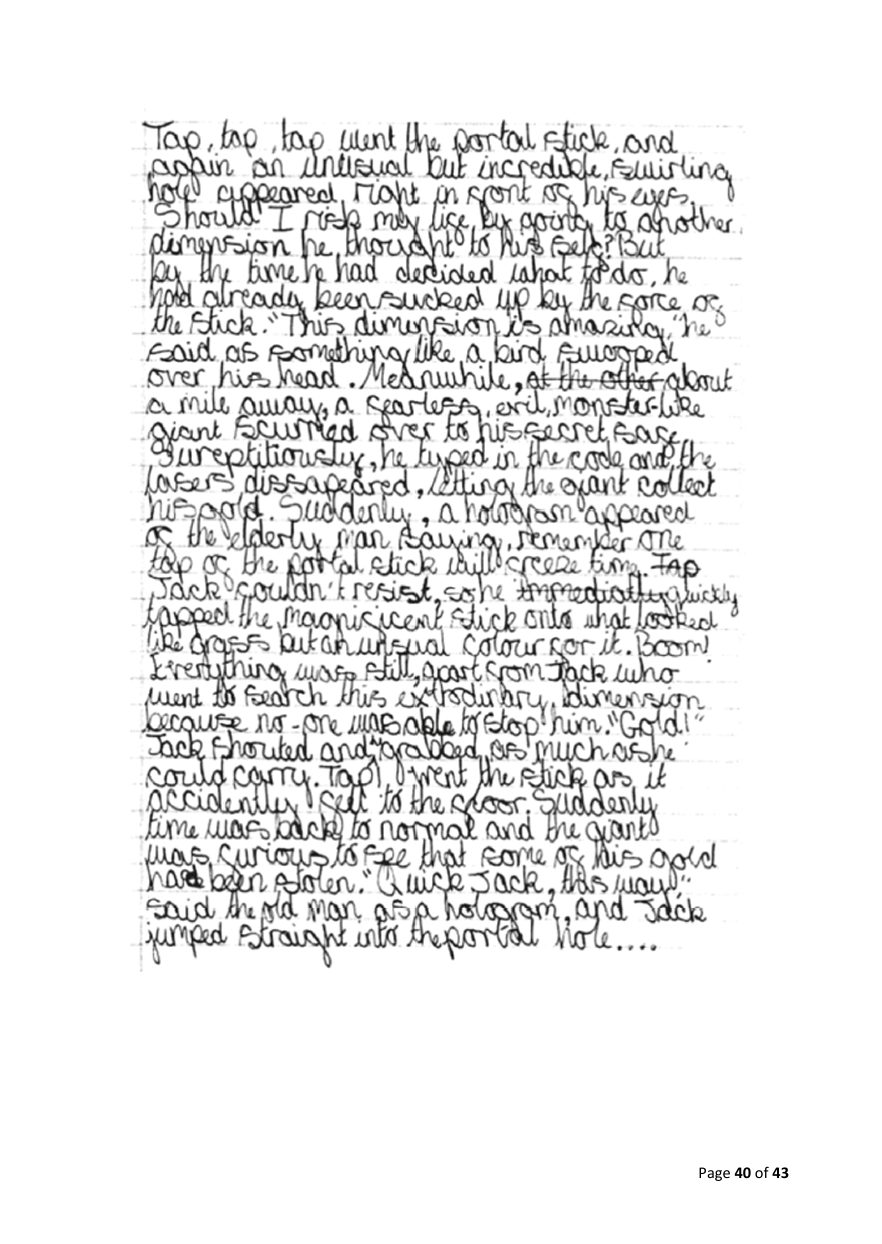
Tap, tap, tap went the portal stick, and again an unusual but incredible, swishing pool appeared right in front of his eyes. “Should I risk my life by going to another dimension,” he thought “Its risky,” but by the time he had decided what to do, he had already been sucked up by the force of the stick. “This dimension is amazing,” he said as something like a bird swooped over his head. Meanwhile, at the tower about Teacher note: This fronted adverbial shifts the reader smoothly to a new location. a mile away, a monster-like giant scurried over to his secret base. Sureptitiously Teacher note: Check this ambitious spelling in a dictionary: 'surreptitiously'., he typed in the code and the lasers disappeared, letting the giant collect his gold. Suddenly, a hooded man appeared at the door, “Man Teacher note: ILLEGIBLE, remember me Tap! Teacher note: ILLEGIBLE what you did Teacher note: ILLEGIBLE. Tap Jack couldn’t resist, so he immediately quickly tapped the magnificent stick onto what looked like grass but an unusual colour for it. Boom! Everything was still, apart from Jack who went to touch this extraordinary shimmering Teacher note: Your ambitious vocabulary builds a mysterious atmosphere. because no one was able to stop him. “Gold!” Jack shouted and grabbed as much as he could carry. Tap! went the stick as it accidently Teacher note: Re-read this ambitious word: it is spelled 'accidentally'. fell to the floor. Suddenly time was back to normal and the giant was furious. “Get out of here, or his gold will be gone!” “Who said this was Teacher note: ILLEGIBLE,” said the old man as a hologram, and Jack jumped straight into the portal hole....
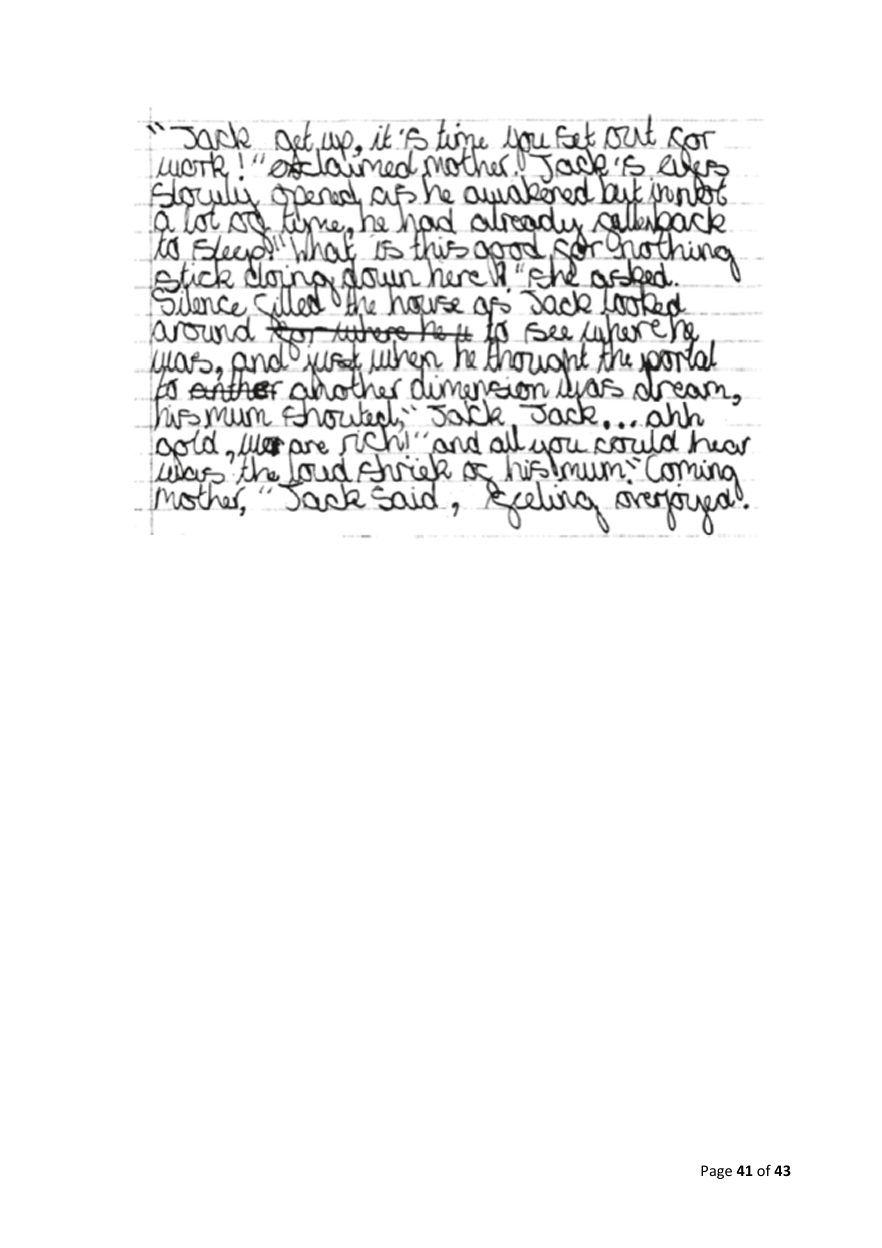
"Jack get up, it's time you set out for work!" exclaimed mother. Jack's eyes slowly opened as he awoke but, not a lot of time, he had already fallen back to sleep! What is this loud? something strange was around here!" he asked. Silence filled the house as Jack looked around Crossed out: for where he to see where he was, and just when he thought the portal to another dimension was a dream, his mum shouted, "Jack, Jack...oh god you are rich!" and all you could hear was the sound of his mum's crying mother, "Jack said, feeling Teacher note: ILLEGIBLE
The improved version — read it straight through, then see what changed
Another Dimension
In 2621, on the planet Zorda, a young but poor boy carefully fixed his droid, which the only source of income he had left. Whilst his mother was busy, the droid constantly shut down in the middle of a game. “Please fix the droid with care,” his mother begged. “And when you’ve finished, take it to the market to be sold.” “Yes, Mother,” Quickly, he picked up the brand-new-looking droid and raced out of the door before she shouted at him again. Within a few minutes, he was already in the alleyway that led to the market when an old man in ragged clothes approached him. “Where are you going with that droid, boy?” asked the curious old man.
The old man examined the droid for a minute and then looked back at Jack. “I will trade you this marvellous stick for it, young man,” he said eagerly. Jack stared at the stick. It was useless and definitely worth nothing. “What? Why would I want , hoping that the old man would leave him alone. Confused by Jack’s words, the old man tried again. “Take the sword or the stick, created for the dark of games,” he added. “You see,” the elderly man said. “See what?” asked Jack, more confused than ever. “The portal to another dimension,” Puzzled, Jack walked over to it, then turned back with a speechless face. “I’ll take the trade, old man!” he shouted, jumping with joy. As soon as the man gave Jack the stick, he was home before he could even breathe.
“You’re back already; where’s the money?” Mother asked, bemused. “See it? No money, Mother—I didn’t get as far as the market,” Jack said. “I traded the sword for this magic stick, which is so much better than money!” Blue rushed to her hands in shock as into something unimaginable. “What do you mean, you traded the sword?” Mother shouted, steam coming out of her ears. “You fool!” she screamed. Feeling ashamed of who she had raised, Mother jumped into her room. Confused, Jack slammed the door shut, determined to see what was in the portal.
Tap, tap, tap went the portal stick, and again an unusual but incredible swishing pool appeared before his eyes. “Should I risk my life by going to another dimension?” he thought. risky.” However, by the time he had decided what to do, the force of the stick had already sucked him up. “This dimension is amazing,” he said as something like a bird swooped over his head. Meanwhile, at a tower about a mile away, a monster-like giant scurried to his secret base. , he typed in the code, and the lasers disappeared, allowing the giant to collect his gold. Suddenly, a hooded man appeared at the door. Jack could not resist: the magnificent stick on what looked like grass, although it was an unusual colour. Boom! Everything was still, apart from Jack, who went to touch the extraordinary shimmering gold because no one could stop him. “Gold!” Jack shouted, grabbing as much as he could carry. Tap! The stick accidentally fell to the floor. Suddenly, time returned to normal and the giant was furious. “Get out of here, or his gold will be gone!” the old man said as a hologram. Jack jumped straight into the portal hole.
“Jack, get up! It’s time you set out for work!” Mother exclaimed. Jack’s eyes slowly opened, but before long, he had fallen back to sleep. “What is this loud, strange sound?” he asked. Silence filled the house as Jack looked around to see where he was. Just when he thought the portal to another dimension had been a dream, his mum shouted, “Jack, Jack… oh God, you are rich!” All he could hear was the sound of his mum crying.
What changed and why
Mark your own piece of writing
Photograph a handwritten piece and get the same report — free to start, no card required.