STA 2018 KS2 Expected Standard
Piece C — Recount
Year 6 · STA Expected Standard · Leigh
Published exemplification — the same live marking as the product, on government or exam-board material, not a pupil’s book. STA KS2 English writing exemplification. Contains material developed by the Standards and Testing Agency for 2018 national curriculum assessments and licenced under Open Government Licence v3.0.
Published script
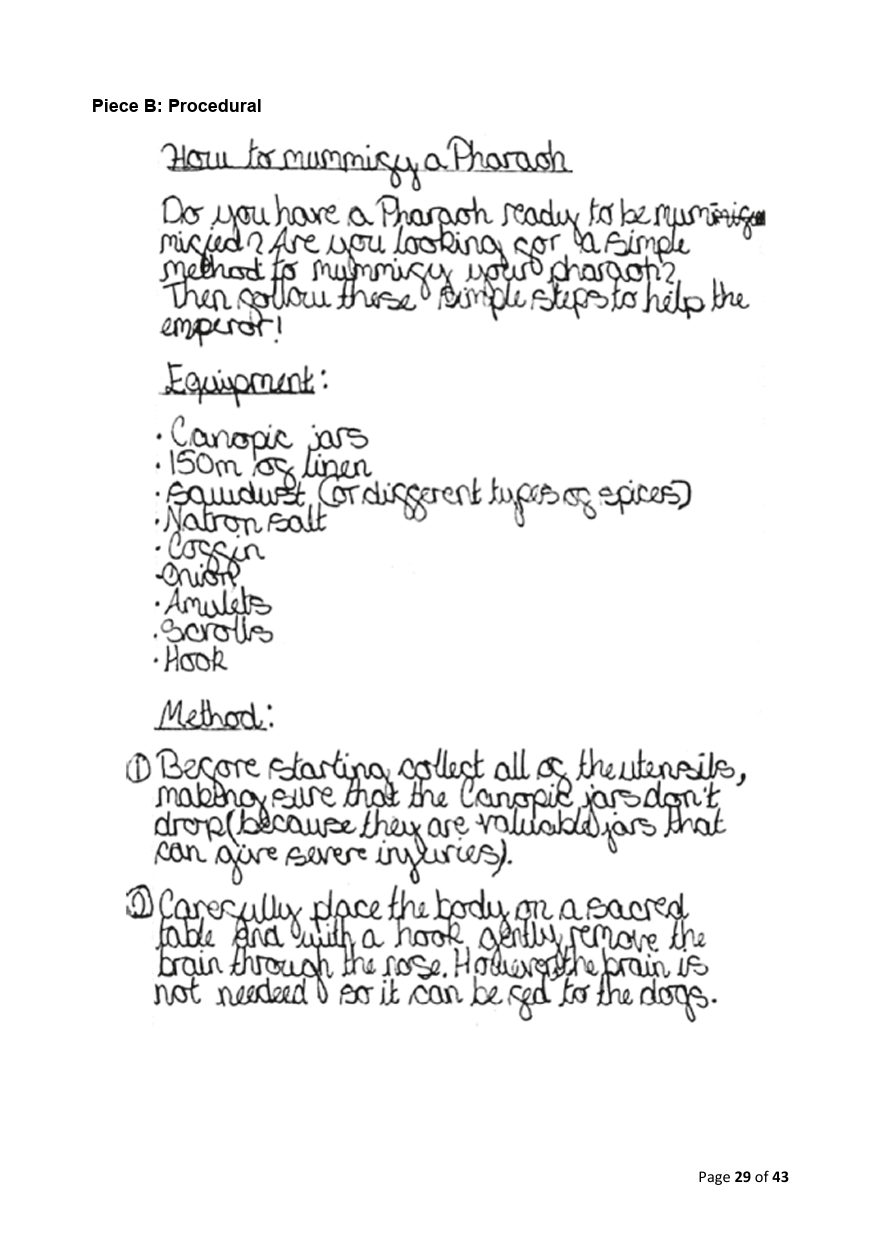
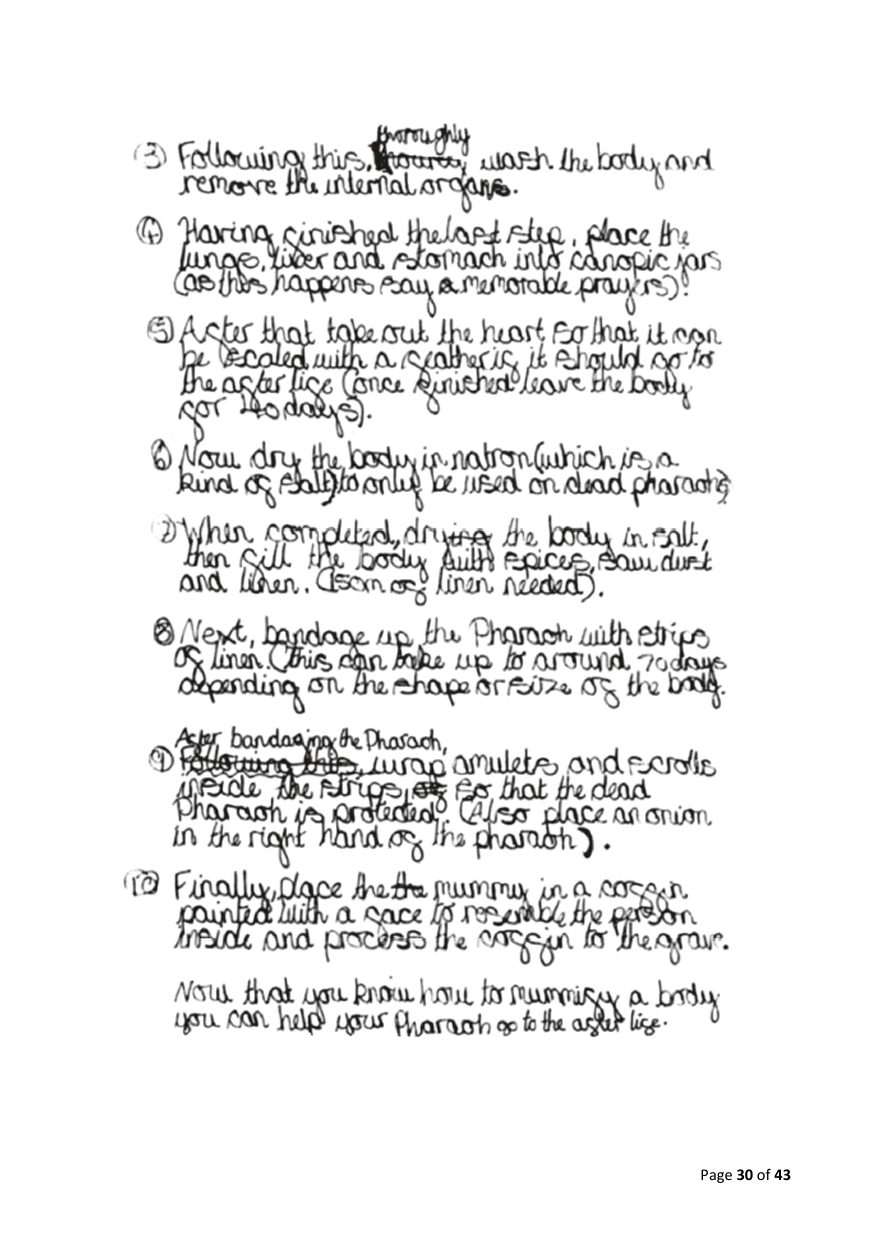
Live marked report
Working at the expected standard
This is a clear and purposeful procedural piece. It uses direct address and step-by-step organisation well, which fits Year 6 expectations for non-narrative writing and reader awareness . The writing is not as tightly controlled as the greater-depth exemplification, but it does show secure expected-standard features, especially in how it guides the reader.
Strengths
You keep the reader in mind from the start with direct address: 'Do you have a Pharaoh ready to be mummified?'
The instructions are well organised with 'Equipment:' and numbered steps, so the process is easy to follow.
You use accurate topic vocabulary such as 'canopic jars', 'natron', 'amulets' and 'scrolls' to make the method sound convincing.
Areas for Development
Some sentences are long or awkwardly joined, which sometimes makes the meaning less clear.
Spelling of key topic words is not yet fully consistent, for example 'Pharoah' and 'after life'.
Punctuation is sometimes uneven inside longer sentences, so the steps would be clearer with more careful editing.
Next Steps
Re-read each step and check that each sentence gives one clear instruction.
Use a dictionary or word list to check the spelling of important topic words before publishing.
Try editing one paragraph at a time to improve sentence clarity and punctuation.
Composition
| Can-statement | Status | Evidence |
|---|---|---|
| write effectively for a range of purposes and audiences, selecting language that shows good awareness of the reader | Met | The opening uses direct address and a rhetorical question: 'Do you have a Pharaoh ready to be mummified?' and 'Then follow these simple steps'. |
| use paragraphs to organise ideas | Met | The piece is clearly sectioned into a title, equipment list and numbered method steps, helping the reader to follow the procedure. |
| in non-narrative writing, use simple devices to structure the writing and support the reader | Met | Headings, bullet points and numbered instructions are used, for example 'Equipment:' and 'Method:' followed by steps 1-10. |
Vocabulary
| Can-statement | Status | Evidence |
|---|---|---|
| select vocabulary and grammatical structures that reflect what the writing requires, doing this mostly appropriately | Met | The writing uses an instructional, formal tone with vocabulary such as 'carefully', 'sacred', 'canopic jars', 'natron' and 'finally'. |
| distinguish between the language of speech and writing and choose the appropriate register | Met | The register is generally suitable for instructions, with direct address and imperative verbs such as 'collect', 'place', 'dry' and 'bandage'. |
Grammar and punctuation
| Can-statement | Status | Evidence |
|---|---|---|
| use capital letters, full stops, question marks, commas for lists and apostrophes for contraction mostly correctly | Met | Capital letters, question marks and list punctuation are mostly secure, for example 'Do you have a Pharaoh ready to be mummified?' and 'don't'. |
| use the range of punctuation taught at key stage 2 mostly correctly | Partially met | There is some wider punctuation use, including colons, brackets and bullets, but it is not always controlled, for example in 'don't drop(because they are valuable) jars that can cause severe injuries)'. |
| use verb tenses consistently and correctly throughout their writing | Met | The procedural style stays in the present/immediate instructional form, with sequencing words such as 'Following this', 'After that' and 'Finally'. |
Spelling
| Can-statement | Status | Evidence |
|---|---|---|
| spell correctly most words from the year 5 / year 6 spelling list, and use a dictionary to check the spelling of uncommon or more ambitious vocabulary | Partially met | Many ambitious words are correct, including 'canopic', 'natron', 'amulets' and 'mummified', but there are recurring errors such as 'Pharoah' and 'after life'. |
Handwriting
| Can-statement | Status | Evidence |
|---|---|---|
| Handwriting (assessed from the original work) | Met | Large cursive writing with variable spacing and uneven letter size.; Joined cursive writing is uneven in size and spacing, with several crowded words. |
Grammar, Punctuation & Spelling security assessment
Sentence structure
“Then follow these simple steps to help your pharaoh!”
“Carefully place the body on a sacred table”
“Next, bandage up the Pharaoh”
The piece uses commands and direct reader address consistently for a procedural text.
“Before starting”
“Following this”
“After that”
“Next”
“Finally”
A clear sequence is maintained across the method.
Punctuation
“Do you have a Pharaoh ready to be mummified?”
“Are you looking for a simple method for mummifying your pharaoh?”
Opening questions engage the reader and fit the instruction style.
“Equipment:”
“Method:”
Headings are clearly marked and the equipment list is introduced effectively.
“Sawdust (or different types of spices)”
“After that take out the heart so that it can be scaled with a feather”
“This can take up to 20 or 70 days depending on the shape or size of the body.”
Some parenthetical and list punctuation is used, though longer sentences are not always controlled.
“don't drop”
Contraction punctuation is used correctly in the opening method step.
Vocabulary
“canopic jars”
“natron”
“amulets”
“scrolls”
“sacred table”
The text includes vocabulary linked to the topic and purpose of the writing.
Spelling
“mummify”
“internal organs”
“valuable”
“severe”
“coffin”
A good number of more ambitious words are spelled correctly.
“Pharoah”
“after life”
“saw dust”
Some key words are not yet secure, especially repeated topic spellings and compound words.
The original writing, exactly as written, with the teacher notes marked
Piece B: Procedural
How to mummify a Pharaoh
Do you have a Pharaoh ready to be mummified? Teacher note: You engage the reader straight away with a direct question. Are you looking for a simple method for mummifying your pharaoh? Then follow these simple steps to help the emperor!
Equipment: Teacher note: Your clear heading helps readers find what they need. • Canopic jars Teacher note: Accurate technical vocabulary makes your instructions sound convincing. • 150m of linen • Sawdust (or different types of spices) • Natron salt Teacher note: You select precise topic vocabulary for the mummification process. • Coffin • Oils • Amulets • Scrolls • Hooks
Method: Teacher note: This heading clearly signals where the instructions begin.
1) Before starting, collect all of the utensils, make sure that the canopic jars don't drop(because they are valuable) jars that can cause severe injuries). Teacher note: Split this long instruction and check the brackets for clarity.
2) Carefully place the body on a sacred table Teacher note: The imperative verb gives the reader a clear action. and with a hook gently remove the brain through the nose. However the brain is not needed for it can be fed to the dogs.
Page 29 of 43
3) Following this, Teacher note: This sequencing phrase clearly links this step to the previous one. thoroughly Crossed out: ILLEGIBLE wash the body and remove the internal organs.
4) Having finished the last step, place the lungs, liver and stomach into canopic jars (as this happens say a memorable prayer).
5) After that take out the heart so that it can be scaled with a feather as it should go to the after life Teacher note: Write the compound word as one word: ‘afterlife’. (once finished have the body for 70 days).
6) Now dry the body in natron (which is a kind of salt) for only be used on dead pharaohs. Teacher note: Reword this sentence so the instruction is complete and clear.
7) When completed, drying the body in salt, then fill the body with spices, saw dust Teacher note: Write this compound word as one word: ‘sawdust’. and linen. (Some of linen needed).
8) Next, Teacher note: This adverbial helps the reader follow the method in order. bandage up the Pharaoh with strips of linen. This can take up to 20 or 70 days depending on the shape or size of the body.
9) After bandaging the Pharaoh, Crossed out: ILLEGIBLE use amulets and scrolls inside the pharaoh for the dead Pharaoh is protected. (Also place an onion in the right hand of the pharaoh).
10) Finally, Teacher note: ‘Finally’ clearly shows that this is the last step. place the mummy in a coffin. painted with a face to resemble the person inside and process the coffin to the grave. Teacher note: Join or punctuate these ideas so the final instruction makes sense.
Now that you know how to mummify a body you can help your Pharoah Teacher note: Check this key topic word in a dictionary: ‘Pharaoh’. go to the after life.
The improved version — read it straight through, then see what changed
Do you have a Pharaoh ready to be mummified? Are you looking for a simple method for mummifying your pharaoh? Then follow these simple steps to help
Equipment: • canopic jars • of linen • sawdust (or different types of spices) • natron salt • coffin • oils • amulets • scrolls • hooks
Method:
1) Before starting, collect all of the cause severe injuries.
2) Carefully place the body on a sacred table and, with a hook, gently remove the brain through the nose. However, the brain is not needed, it can be fed to the dogs.
3) Following this, thoroughly wash the body and remove the internal organs.
4)
5) After that, take out the heart so that it can be the body for 70 days.
6) Now dry the body in natron, which is a kind of salt only be used on dead pharaohs.
7) When needed.
8) Next, bandage up the Pharaoh with strips of linen. This can take 70 days, depending on the shape or size of the body.
9) After bandaging the Pharaoh, use amulets and scrolls inside the pharaoh the dead Pharaoh is protected. Also, place an onion in the right hand of the pharaoh.
10) Finally, place the mummy in a coffin painted with a face to resemble the person inside,
What changed and why
Mark your own piece of writing
Photograph a handwritten piece and get the same report — free to start, no card required.