Which year group?

1. Photograph the page
Nothing to type up
Pick the year group and photograph the writing — several pages if the piece runs long. The year sets the National Curriculum expectations and the matching KS2 framework.
Photograph the page. You get a proposed KS2 standard — working towards, expected or greater depth — the “pupil can” statements it is evidenced against, and next steps on structure, cohesion and accuracy. You confirm the judgement.
“I liked how it showed me where I did well and gave a new version of my story.”
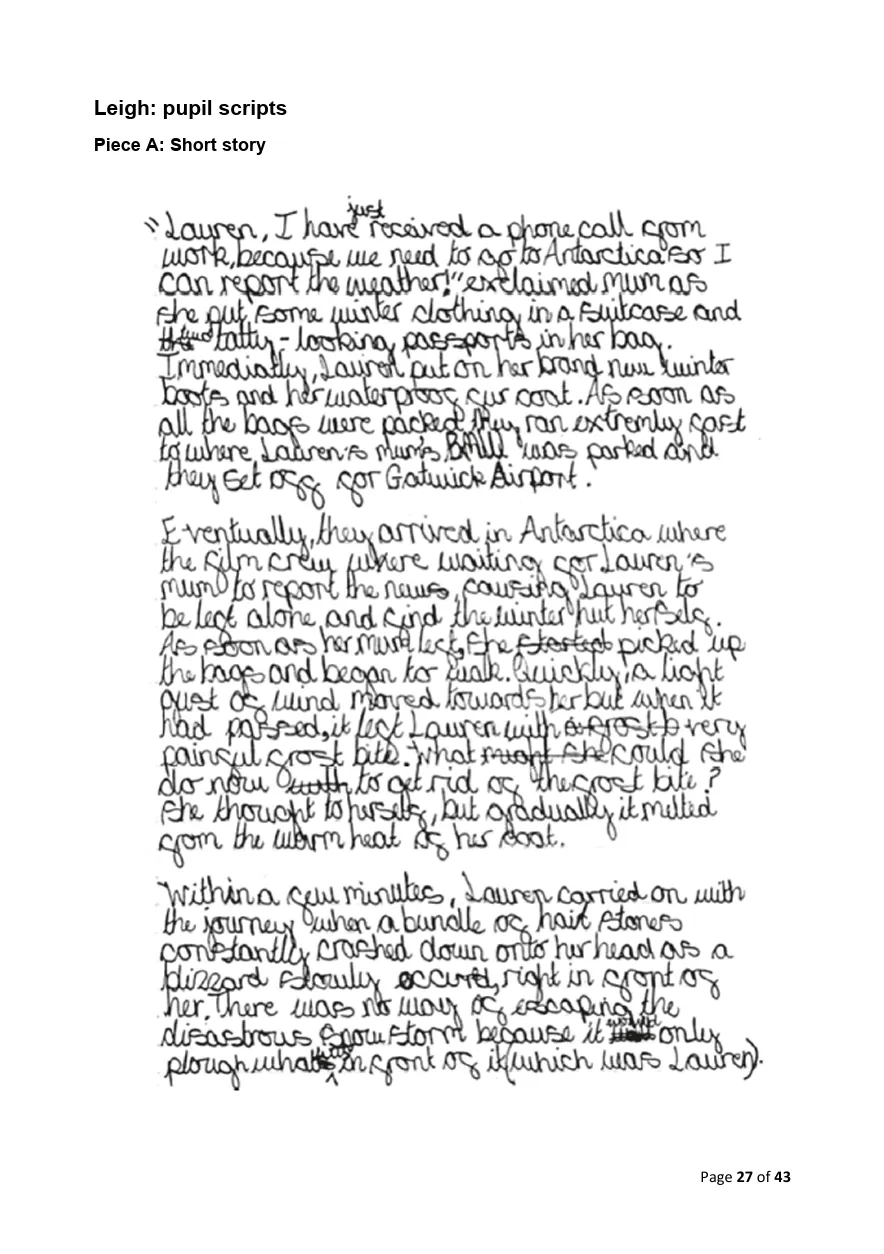
The writing below is STA 2018 exemplification — Leigh, Year 6, working at the expected standard. We use it so you can see the whole loop on a public collection instead of a pupil’s book.
Which year group?

1. Photograph the page
Pick the year group and photograph the writing — several pages if the piece runs long. The year sets the National Curriculum expectations and the matching KS2 framework.
KS2 Writing Assessment
Working at the Expected Standard
Narrative
Writes for a purpose with a clear opening and sequence.
Sentence demarcation is consistent enough for this standard.
Speech punctuation is the remaining next step.
2. Confirm the standard
Strengths, next steps, and an evidence matrix against the “pupil can” statements. Every claim points at something in the child’s own writing — so you are checking a judgement, not taking one on trust.
ReMarkAble AI
KS2 writing report
Working at the Expected Standard
Keep a copy for books, parents and the next time you look at this pupil’s writing. Quoted evidence stays with the piece.
3. Keep the record
Each marked page stays in the assessment history. Premium PDF for books, parents and internal moderation — so the picture builds across the term rather than being assembled in June.
Year 6 · 6 pieces
Across narrative, recount and diary pieces, the remaining gap is keeping one verb tense going inside a paragraph rather than drifting mid-piece.
15–20 minute lesson on the most consistent TAF gap across the collection.
4. Teach the gap
Across Leigh’s six pieces the remaining gap was punctuating direct speech. That became a 15–20 minute lesson — so the time you save on marking goes back into teaching, not into a generic worksheet.
Year 6 collection (Leigh)
KS2 · 6 pieces
Working at the Expected Standard
Overall standard across the body of work. A teacher agreed the judgement.
5. Moderate the collection
KS2 writing is judged as a collection, not a single strong piece. Propose one overall standard across the pieces; a teacher agrees it. That is the moderation conversation, with the evidence already quoted.
Leigh’s six pieces — the same framework language on every one, so the collection can be moderated as a body of work.
Contains material developed by the Standards and Testing Agency for 2018 national curriculum assessments and licenced under Open Government Licence v3.0. View the licence. Source: KS1 Kim and KS2 Leigh on GOV.UK. Live marked packs: Year 2 Kim and Year 6 Leigh.
Not a replacement for teacher assessment. A way to mark more extended writing, keep the language the same across a year group, and spend the time you save on teaching.
Photograph the page and confirm a proposed standard, instead of writing the same paragraph-level comment on thirty books.
Every piece is judged against the same KS2 framework language, so two parallel classes are not marked to two different bars.
Organisation, paragraphing, cohesion and subject vocabulary — the things that separate the bands by Year 6, not just spelling.
Two or three specific moves, quoted against the child's own writing. The piece is never rewritten for them.
Every marked piece is kept, so the collection builds across the term instead of being assembled the week before.
A proposal with the evidence quoted. You confirm it — and if you override it, the original is kept alongside your judgement.
Years 3 to 6 are assessed against the KS2 writing framework, so the report, the lesson and the collection judgement all use the language you take into a moderation meeting.
WTS
Working Towards the Expected Standard
EXS
Working at the Expected Standard
GDS
Working at Greater Depth
This marks against KS2 expectations, not GCSE ones. What carries forward is the habit — planning a structure before writing, holding cohesion across paragraphs, and acting on one named next step instead of a page of corrections. When those pupils reach GCSE, the same platform marks that work against the exam board mark scheme.
See GCSE markingPhotograph something already in a book. If the proposed standard is not one you would have given, you have lost two minutes — and you will know exactly where it disagreed with you.
School plans from £49/month or £500/year. Prices exclude VAT where applicable. See school pricing.