Save marking time
Photograph the page. Confirm proposed marks and a next step instead of writing the same comments after school.
Attach each pupil's scripts, submit once, and come back to a marked class set — every mark grounded in the real exam board mark scheme, every comment quoting the pupil's own writing. You review, override what you disagree with, and release the lot together.
ReMarkAble turns a class set of work into reviewed feedback, a live markbook and evidence-led teaching actions — while the teacher keeps control of every judgement a pupil sees.
The marking agent cannot answer without retrieving the actual exam board mark scheme — and we count whether it did, after the run, rather than taking its word for it. Across all marking from July to 23 September 2026: 898 pieces marked, 896 recorded as grounded and none recorded as ungrounded.
Every piece of evidence in the feedback is matched back against the pupil's own transcript. Of 7,288 quotes, 6,885 verified automatically.
86 live mark scheme stores, 264 papers and 1,637 seeded questions with their marks, sections and assessment objectives — across AQA, Edexcel, OCR, Eduqas and WJEC, plus KS1, KS2, 11+ and Years 1–6.
Quote verification is fidelity against the pupil transcript, not a marking accuracy percentage. We do not publish one.
1. Submit the class, not the script
Choose the paper. Attach each pupil's work — photographed handwriting or typed. Submit once. Every script marks in parallel and you can close the tab; anything that stalls is swept up automatically.
2. Moderate on one screen
The class set arrives in one moderation board, not thirty separate reports. Approve what you agree with, override the marks, grades and feedback you don't. The original AI judgement is kept alongside yours for audit. Nothing is visible to a pupil until you release it.
3. The markbook fills itself
Marks, grades, percentages and trends land per pupil per paper without anyone typing anything into a spreadsheet. Shared gaps across the class are ranked for you, with the pupils affected already grouped.
Not a replacement for teacher marking. A way to mark more essays, keep AO language consistent, and spend the time you save on teaching — with you still releasing every judgement.
Photograph the page. Confirm proposed marks and a next step instead of writing the same comments after school.
Board-aligned marks with AO breakdowns students can use when they redraft.
Every proposed mark can be confirmed or overridden. The original is kept if you change it.
Students practise between lessons and arrive already knowing what to work on.
Feedback names the next step in AO language, so the following lesson has a target.
Each marked piece stays in the history, so you can see the trail across the term.
The handwriting below is from AQA’s published Answers and commentaries for GCSE English Language 8700 Paper 2: Writers' viewpoints and perspectives (from 2026) — so you can see the full loop on a public collection, not a pupil’s book.
Paper
Question
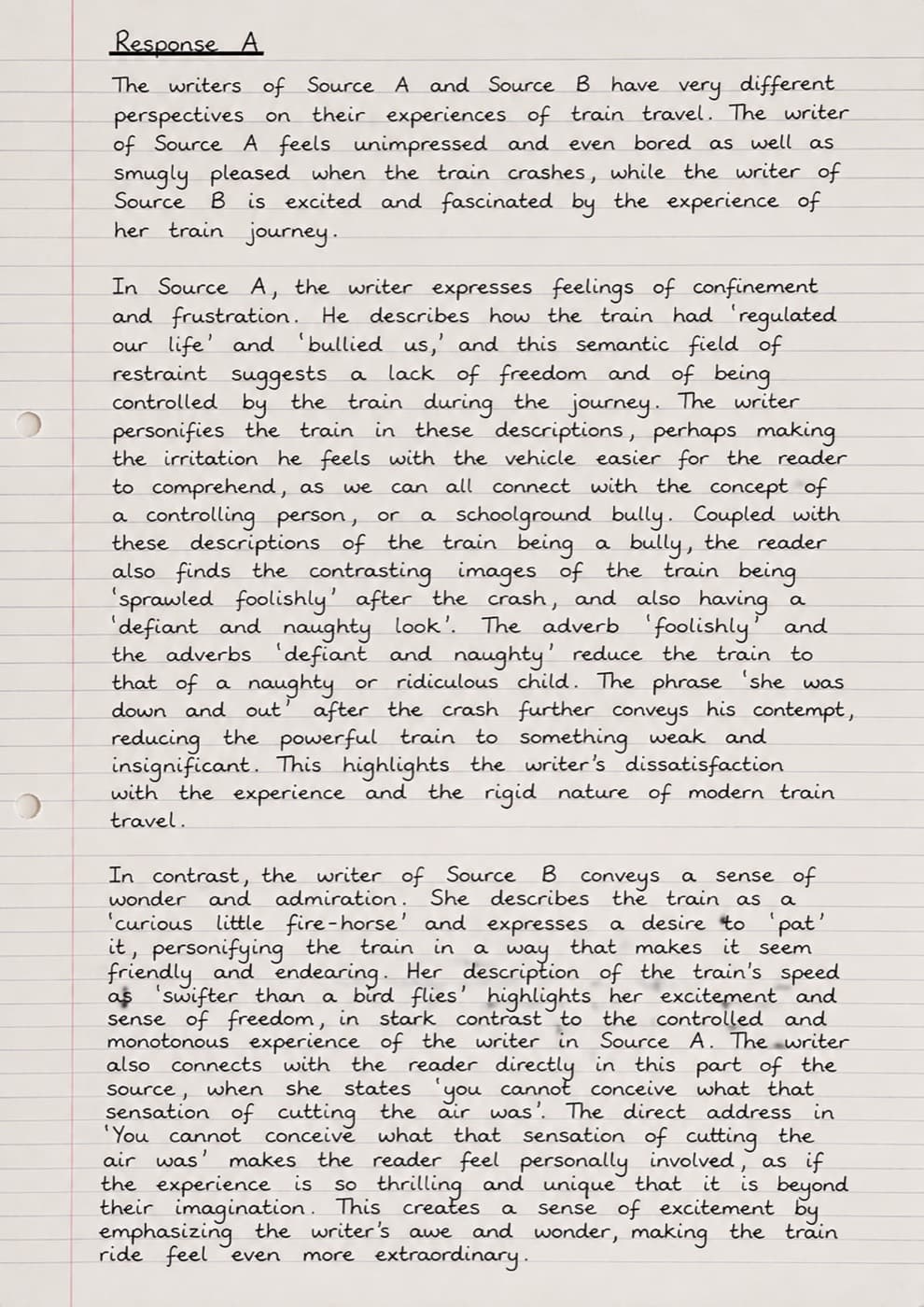
1. Upload the answer
Handwritten pages are read as they are — no typing required. The paper and question set the mark scheme and assessment objectives, so the feedback is usable that afternoon.
GCSE English Language · Q4
Indicative grade 9
Compare perspectives · 94%
You compare both sources directly and repeatedly, rather than writing about them separately.
You analyse methods with relevant terminology, such as 'semantic field', 'personifies', and 'direct address'.
Link the two writers more explicitly within each paragraph — whereas, similarly, in contrast.
2. Online report
Marks against the question total, an indicative grade, strengths and a next step. In a school, a teacher confirms or overrides every mark before pupils see it. The same wording across a class makes department standardisation faster.
3. Compare with AQA
Question 4 and Question 5 sit in the Level 4 band AQA published. Question 2 was published as Level 3; we awarded 6/8, inside that published band. In school marking, a teacher has the final say.
| Question | AQA published | ReMarkAble |
|---|---|---|
Q2 · Summary comparison Response B · 8 marks | Level 3 | 6/8 Sits in the published band |
Q4 · Compare perspectives Response A · 16 marks | Level 4 | 15/16 Sits in the published band |
Q5 · Transactional writing Response A · 40 marks | Level 4 | 37/40 Sits in the published band |
ReMarkAble AI
AQA 8700 Paper 2 · Q4
Indicative grade 9
Keep a copy for books, parents and the next time this student writes. AO marks and next steps stay with the piece.
4. A record of progress
Each marked page stays in the history. Premium PDF for books, parents and the next time you look at this student. You can see whether the marks and the next steps are moving.
GCSE English Language · Q5
Indicative grade 9
Transactional writing · 93%
Effective rhetorical opening with 'Ladies and gentlemen - we stand at a crossroads.'
Clear paragraphing and logical progression through three convincing arguments.
Develop a more memorable closing so the argument ends with a sharper final impact.
5. Teach the remaining gap
On this Question 5 speech the remaining gap was a sharper closing. On Question 4 it was linking the two writers inside each paragraph. The time you save on marking goes into teaching that next step — across a class, not one book at a time.
These three responses appear in AQA’s published answers and commentaries. We uploaded the handwriting to the live product — Q4 awarded 15/16 — so you can see upload, report and comparison without putting a pupil’s work on a public page.
Q2 · Summary comparison · AQA Level 3
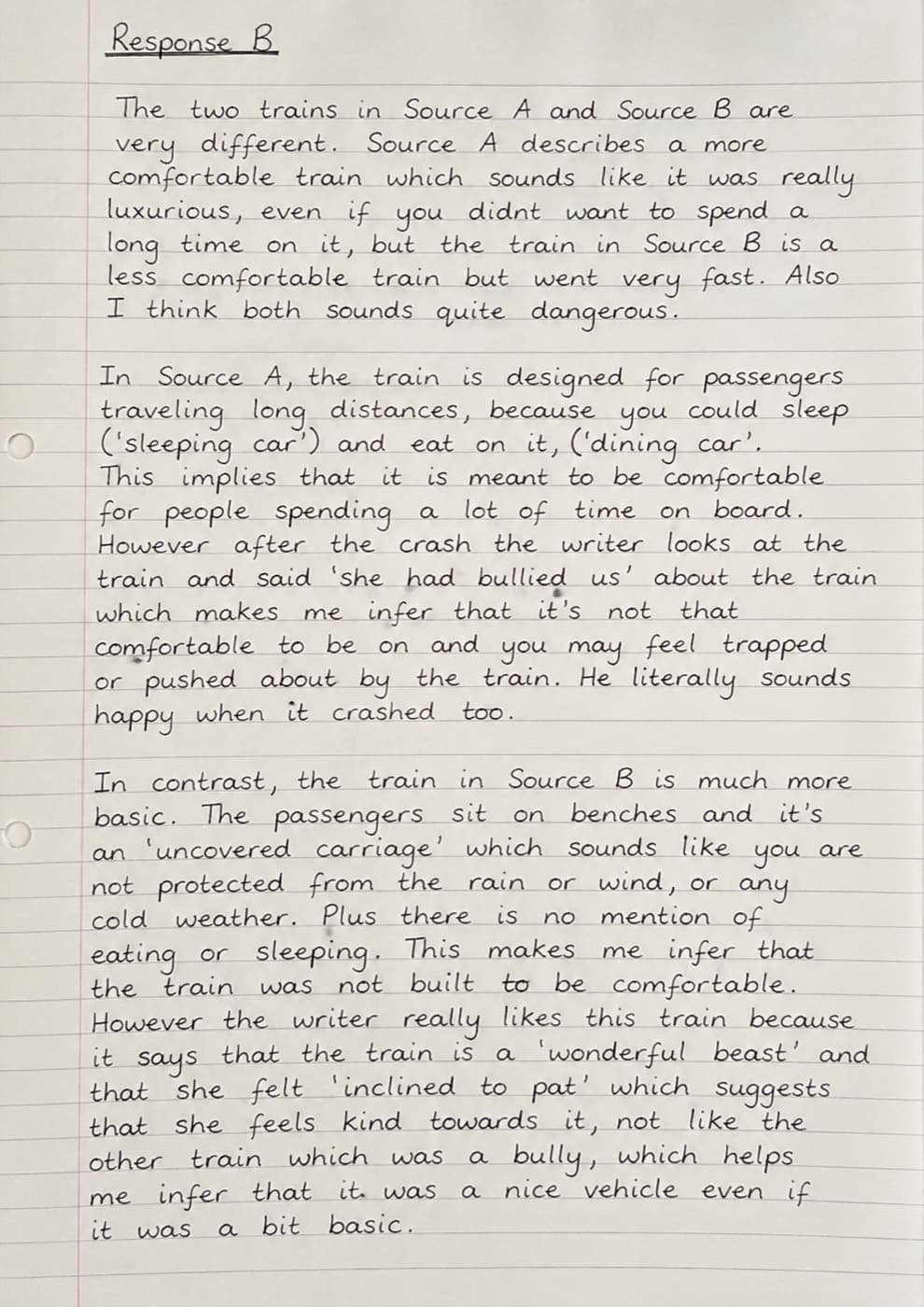
GCSE English Language · Q2
Indicative grade 7
Summary comparison · 75%
You compare the sources directly rather than writing about them separately.
You make clear inferences from detail such as ‘sleeping car’ and ‘uncovered carriage’.
Keep each inference tightly linked to the evidence; avoid speculative comment.
Q4 · Compare perspectives · AQA Level 4
GCSE English Language · Q4
Indicative grade 9
Compare perspectives · 94%
You compare both sources directly and repeatedly, rather than writing about them separately.
You analyse methods with relevant terminology, such as 'semantic field', 'personifies', and 'direct address'.
Link the two writers more explicitly within each paragraph — whereas, similarly, in contrast.
Q5 · Transactional writing · AQA Level 4
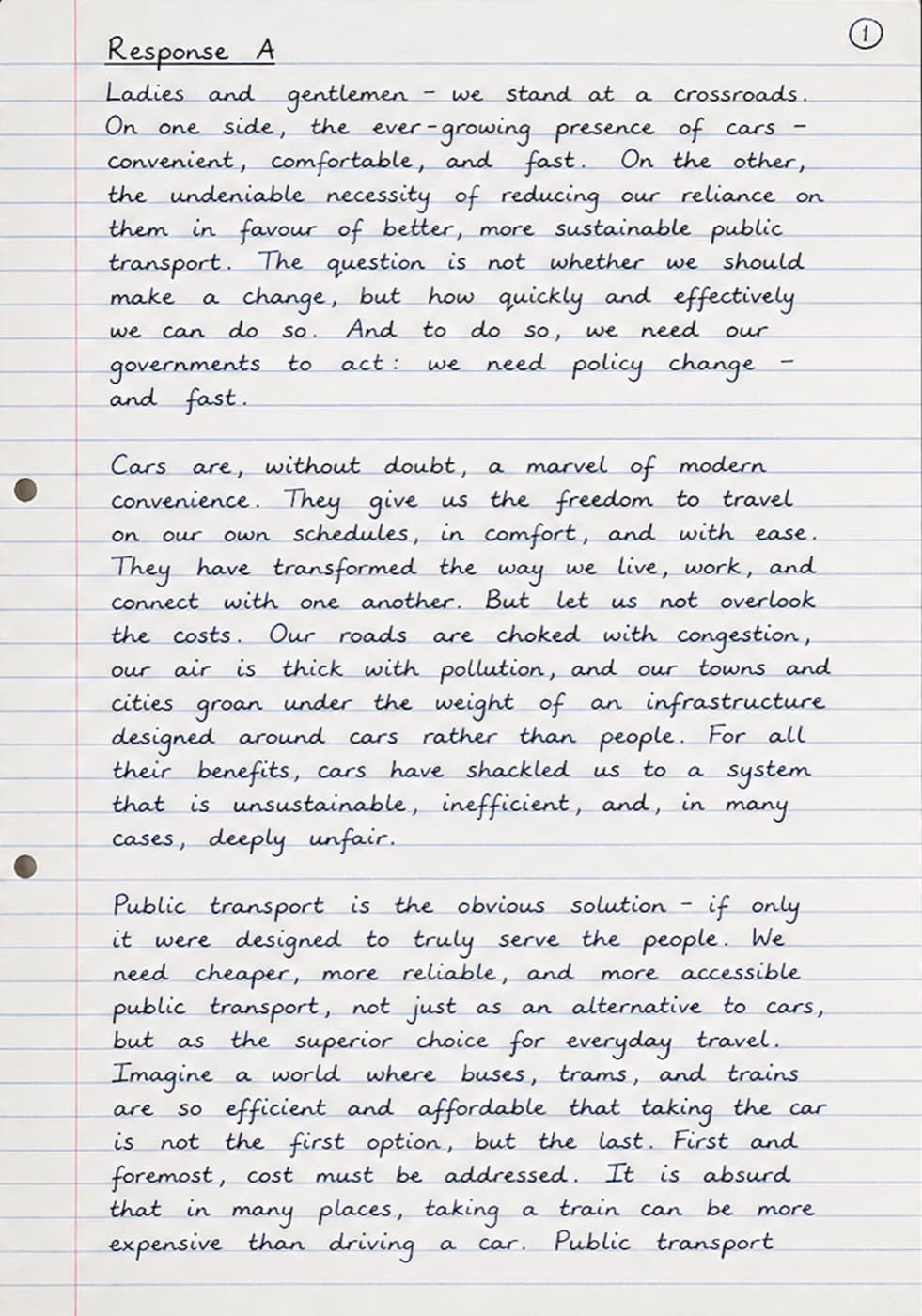
GCSE English Language · Q5
Indicative grade 9
Transactional writing · 93%
Effective rhetorical opening with 'Ladies and gentlemen - we stand at a crossroads.'
Clear paragraphing and logical progression through three convincing arguments.
Develop a more memorable closing so the argument ends with a sharper final impact.
Handwritten responses and published levels are from AQA GCSE English Language (8700) Paper 2 Answers and commentaries (from 2026, v1.1 June 2025). ReMarkAble AI is not affiliated with or endorsed by AQA. Shown so departments can compare live marks with published exemplification, not a pupil’s book. See a live marked example.
Every school leader buying AI assessment is really buying an answer to three questions: is it just guessing, who is accountable for the mark, and will the data stand up in a conversation with a governor or an inspector. Here is how ReMarkAble answers them.
Reporting you get today: termly KPIs (assessments, pupils assessed, below expected, improving, active teachers), half-term progress series, attainment bands, class reports, the intervention lifecycle, and a report catalogue that states plainly what each report can and cannot produce. School-level reports export as CSV. Individual assessment reports and lesson plans export as PDF.
Pick the paper, attach the scripts, submit. They mark in parallel and you can close the laptop.
Not thirty PDFs. Override what you disagree with, release together.
Marks, grades, percentages, trends — per pupil, per paper, no typing.
for the whole class or a single batch. Parents' evening and books in one action.
Shared weaknesses are ranked across the class, with the pupils affected, the severity and the supporting evidence. A gap has to reach half of an assessed cohort of at least five before we'll call it class-wide — because "your whole class needs this" off four scripts is how a tool loses a teacher for good.
Generate a teaching plan against the gaps your class actually has, then reassess.
Identify, group, teach, reassess — with each group's stage visible instead of a flat list.
Awaiting moderation, awaiting release, pupils below expectation, pupils declining, pupils not yet assessed.
Log a piece as independent, supported or heavily scaffolded for your moderation evidence. The marker never sees it, so it cannot bias the mark.
CSV, columns in any order. Pupil accounts are optional — you can mark work for children who have no login at all.
between years.
No independent reviewer benchmark exists for our marking yet, so any number we gave you would be marketing. What we can evidence is that every mark is grounded in the real mark scheme and every quote is checked against the pupil's work — and we publish those figures above.
The system produces a first mark. You decide what a pupil sees. That is the design, not a limitation of it.
We can show you the gap, the group and the teaching that followed. We cannot yet show you a clean before-and-after, so we don't pretend to.
We import your register from CSV, including the usual MIS export formats. That is not the same thing, and we won't say it is.
“Our English department used this for moderation — every script had consistent, clear feedback.”
Teachers confirm or override every proposed mark. Nothing reaches a pupil until you release it.
Prefer a single marked script first? See an AQA Paper 2 answer marked, no signup.
Fourteen days. Up to 30 pupils and 100 assessments. No card, no automatic billing, nothing to cancel. Mark a real set of your own scripts, moderate it, and look at what the markbook does with it.
If you want to see it working before you commit even that, ask for the demo school — a real class in use, with data already in it.