Predicted grade (indicative)
Marks
Score
This grade is indicative only — it comes from a single 16-mark question, not a full paper. Use the marks and feedback below as the real signal.
What to do next
Practise AO3 comparison paragraphs by writing one point, one Source A quote, one Source B quote, and a direct comparison sentence at the end of each paragraph.
You compare both texts within the same paragraph, rather than treating them separately, which is exactly what AO3 rewards.
You analyse methods such as personification, semantic field and direct address to show how each writer’s perspective is conveyed.
Push beyond identifying methods to explain the overall perspective each writer creates across the whole source, not just the immediate effect of a phrase.
Make comparative judgements more explicit, for example by stating how Source A is more critical while Source B is more admiring in each paragraph.
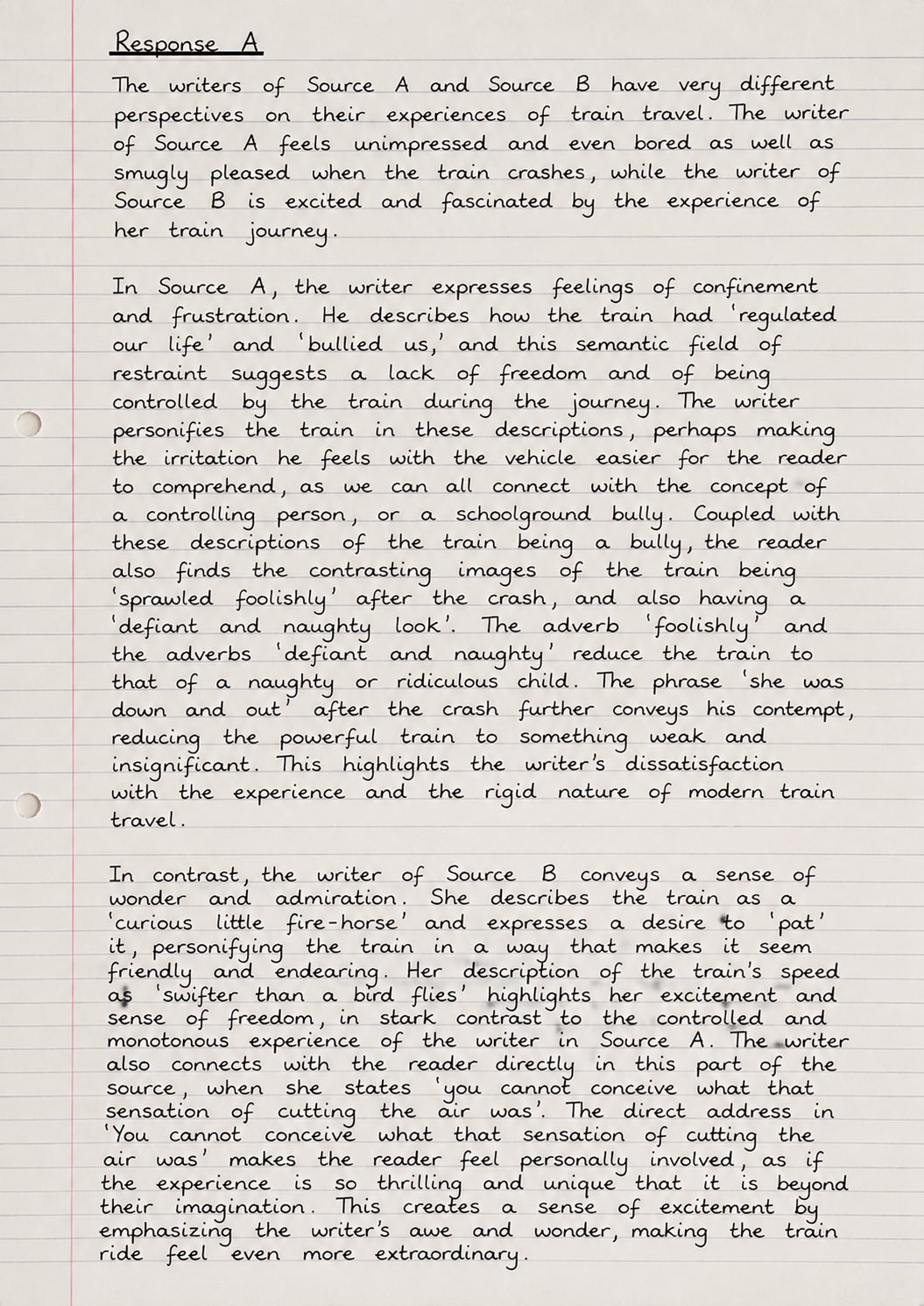
This is a strong comparative response with a clear line of argument from the opening sentence. You consistently compare both writers’ perspectives and support each point with precise quotations, which places the answer securely in the top level.
Strengths
You compare both texts within the same paragraph, rather than treating them separately, which is exactly what AO3 rewards.
You analyse methods such as personification, semantic field and direct address to show how each writer’s perspective is conveyed.
Your quotations are well selected and closely linked to the point being made, especially in Source A and Source B.
Areas for improvement
Push beyond identifying methods to explain the overall perspective each writer creates across the whole source, not just the immediate effect of a phrase.
Make comparative judgements more explicit, for example by stating how Source A is more critical while Source B is more admiring in each paragraph.
Use slightly more precise terminology where needed, such as avoiding repeated references to 'adverbs' when the language feature is more accurately an adjective phrase or descriptive phrase.
Next steps
Practise AO3 comparison paragraphs by writing one point, one Source A quote, one Source B quote, and a direct comparison sentence at the end of each paragraph.
Revise how to explain effect in full: after naming a method, add 'this suggests...' or 'therefore the writer presents...' to show perspective, which is needed for Level 4.
Work on whole-text perspective statements so each paragraph ends with a clear verdict on how each writer feels about the topic and why that matters to the reader.
Assessment objective
15/16
94%
Sustained, integrated comparison of both writers' perspectives on train travel, with clear analysis of methods such as personification, semantic field, contrast and direct address. The response is perceptive and well-supported, though not fully polished into a consistently nuanced whole-text argument, so it sits just below full marks.
The improved version — read it straight through, then see what changed
The writers of Source A and Source B
In Source A, the writer conveys confinement and resentment. He claims that the train had ‘regulated our life’ and ‘bullied us’: a ‘defiant and naughty look’; the adverb ‘foolishly’ and the
Conversely, Source B presents the train with affectionate awe. Calling it a ‘curious little fire-horse’ and wanting to ‘pat’ it personifies the engine as a friendly, spirited animal, rather than Source A’s threatening ‘bully’. Her
What changed and why
AI-Generated Assessment
This feedback was generated by AI aligned to the UK National Curriculum. While highly accurate, it is intended to assist rather than replace professional judgment. Final grades and feedback should always be verified by a qualified teacher.