Predicted grade (indicative)
Marks
Score
This grade is indicative only — it comes from a single 40-mark question, not a full paper. Use the marks and feedback below as the real signal.
What to do next
Practise writing a full persuasive ending that circles back to your opening idea; this targets AO5 Level 4 because a strong final paragraph helps sustain the overall argument.
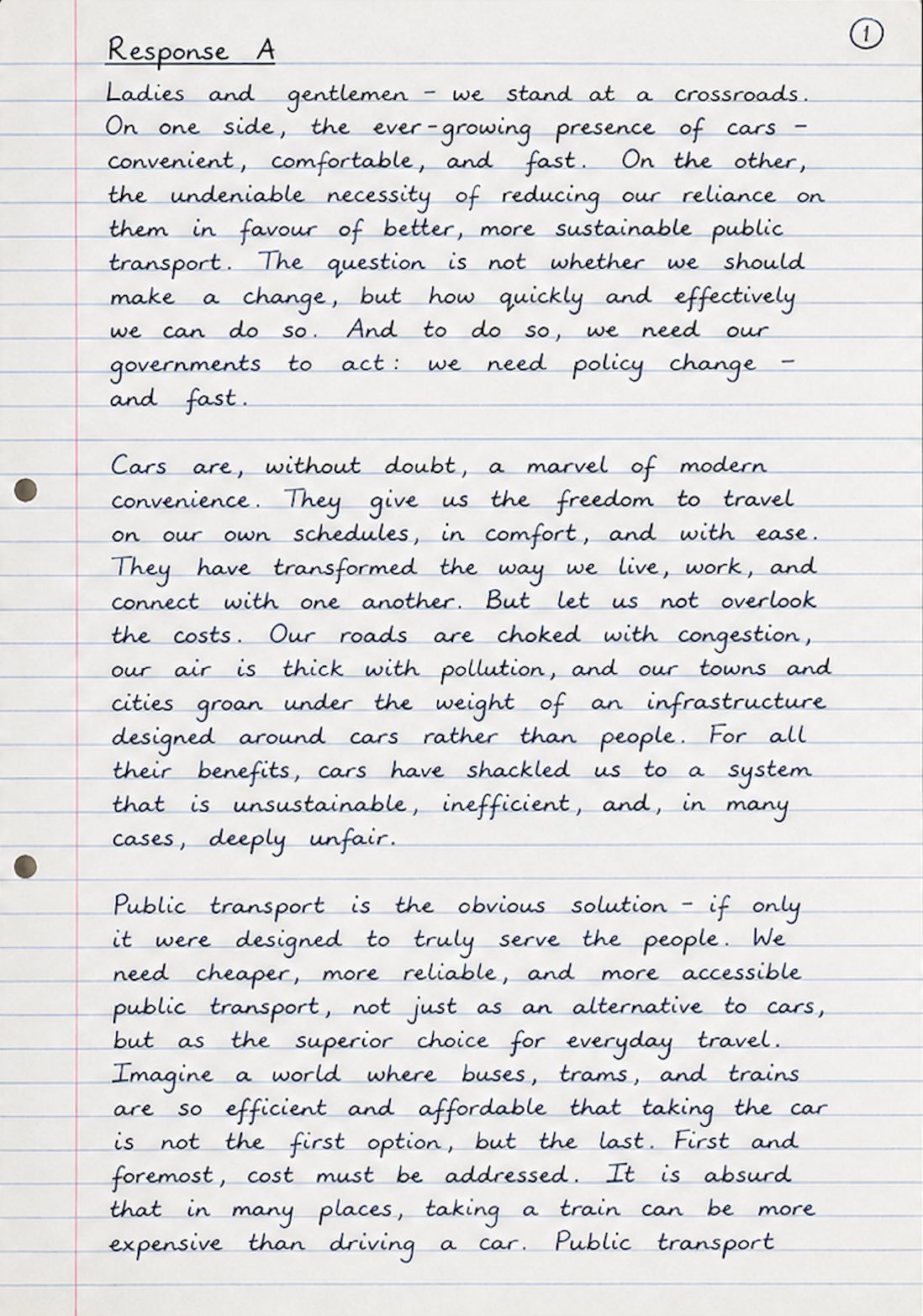
Strong rhetorical opening with direct address and a vivid sense of urgency.
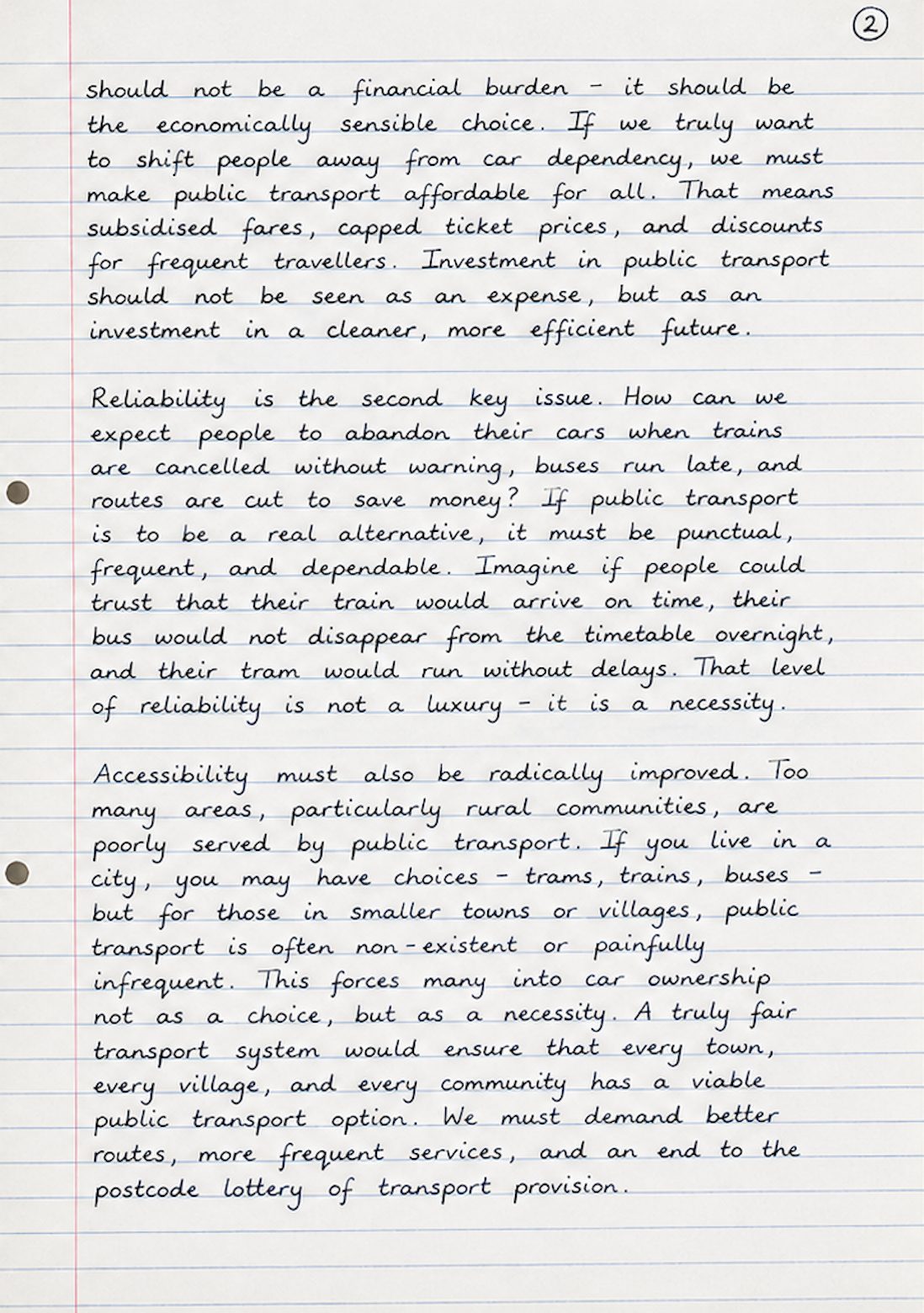
Well-developed paragraphs on cost, reliability and accessibility show clear organisation.
Add a concluding paragraph that returns to the opening idea and leaves the reader with a sharper final impression.
Vary some sentence openings to avoid repeated patterns such as 'we need' and keep the argument feeling even more dynamic.
This is a strong, persuasive viewpoint piece with a clear argument for reducing car dependency and improving public transport. The piece is confidently organised and engaging throughout, although a more decisive ending would make the overall impact even stronger.
Strengths
Strong rhetorical opening with direct address and a vivid sense of urgency.
Well-developed paragraphs on cost, reliability and accessibility show clear organisation.
Accurate punctuation and varied sentence forms give the writing control and fluency.
Areas for improvement
Add a concluding paragraph that returns to the opening idea and leaves the reader with a sharper final impression.
Vary some sentence openings to avoid repeated patterns such as 'we need' and keep the argument feeling even more dynamic.
Develop one or two points with a more specific example or illustrative detail to make the persuasion even more convincing.
Next steps
Practise writing a full persuasive ending that circles back to your opening idea; this targets AO5 Level 4 because a strong final paragraph helps sustain the overall argument.
Practise adding one counterargument and a rebuttal, such as acknowledging car convenience before rejecting over-reliance on cars; this strengthens AO5 because it makes the viewpoint more convincing.
Do a timed punctuation check on your own writing, focusing on commas, dashes and sentence variety; this targets AO6 Level 4 by keeping accuracy high under exam pressure.
Assessment objective
22/24
92%
Compelling, sustained viewpoint on car dependency versus public transport; the direct address, rhetorical questions, imperatives, and clearly sequenced paragraphs create a fluent and persuasive piece for an audience.
Assessment objective
15/16
94%
Spelling and punctuation are highly accurate, and sentence structures are varied and controlled. The writing reads fluently with only very minor slips, none of which impede meaning.
The improved version — read it straight through, then see what changed
Ladies and gentlemen — we stand at a crossroads.
On one side the undeniable necessity of reducing our reliance on them in favour of better, more sustainable public transport. The question is not whether we should act: we need policy change — and fast.
Cars are, without doubt, a marvel of modern convenience. They give us the freedom to travel to our own schedules, in comfort and with ease. They have transformed the way we live, work and connect with one another. But infrastructure designed around cars rather than people. For all their benefits, cars have shackled us to a system that is unsustainable, inefficient and, in many cases, deeply unfair.
Public transport is the obvious solution — if only it were designed to truly serve the people. We need cheaper, more reliable and more accessible public transport: not the superior choice for everyday travel. Imagine a world where buses, trams and trains are so efficient and affordable that taking the car is not the first option, but the last.
First and foremost, cost must be addressed. It is absurd that, in many places, taking a train can cost more than driving a car. Public transport should not be a financial burden; it should be the economically sensible choice. subsidised fares, capped ticket prices and discounts for frequent travellers. Investment in public transport should not be dismissed as an expense, but recognised as an investment in a cleaner, more efficient future.
Reliability is the second key issue. How can we expect people to abandon their cars when trains are cancelled without warning, buses run late and routes are cut to save money? If public transport is to alternative, it must be punctual, frequent and dependable. Imagine if people could trust that their train would arrive on time, their bus would not disappear from the timetable overnight and their tram would run without delay. it is a necessity.
Accessibility must also be radically improved. Too many areas, particularly rural communities, are poorly served by public transport. If you live in a city, you may have choices — trams, trains, buses — but for those in smaller towns or villages, public transport is often non-existent or painfully infrequent. This forces many into car ownership not as a choice, but as a necessity. A truly fair transport system would ensure that every town, village and community has a viable public-transport option. We must demand better routes, more frequent services and an end to the postcode lottery of transport provision.
What changed and why
AI-Generated Assessment
This feedback was generated by AI aligned to the UK National Curriculum. While highly accurate, it is intended to assist rather than replace professional judgment. Final grades and feedback should always be verified by a qualified teacher.