STA 2018 KS2 Expected Standard
Piece B — Non-chronological report
Year 6 · STA Expected Standard · Leigh
Published exemplification — the same live marking as the product, on government or exam-board material, not a pupil’s book. STA KS2 English writing exemplification. Contains material developed by the Standards and Testing Agency for 2018 national curriculum assessments and licenced under Open Government Licence v3.0.
Published script
Live marked report
Working towards the expected standard
You have written a lively recount that clearly takes the reader through the trip to the Globe and the visit around London. Your writing keeps the events in order and shows real interest in what you learned. To move into the expected standard, you now need tighter control of sentences, punctuation and spelling so that your ideas are easier to follow.
Strengths
You organise the recount clearly across paragraphs, moving from the Globe theatre to the acting workshop and then to the walk around London.
You use time openers and linking phrases well, for example 'To begin the day', 'As the day carried on' and 'Just after we finished our lunch'.
Your writing shows strong interest and engagement, with comments such as 'unexpected and shocking' and 'I would definitely like to come and watch a play there!'.
You include some ambitious vocabulary and explanation, such as 'status', 'beautiful detailed painting' and 'co-operating together'.
Areas for Development
Some sentences run on or become unclear, so it would help to keep one main idea in each sentence and use full stops more securely.
Check capital letters and apostrophes carefully, especially in proper nouns and contractions such as 'Shakespeare's', 'I've' and 'didn't'.
Proofread Year 5/6 spellings, for example 'definitely' and 'Shakespeare', as several ambitious words are not yet secure.
Aim to finish every sentence clearly; the ending feels incomplete in places.
Next Steps
After writing, read each sentence aloud and check that it has a clear start, full stop and correct capital letter.
Composition
| Can-statement | Status | Evidence |
|---|---|---|
| write for a range of purposes | Met | This is a clear recount of a visit: 'Our trip to the Globe' and 'I had an interesting day learning new things'. |
| use paragraphs to organise ideas | Met | The writing moves through separate sections, including the Globe visit, workshop and London walk. |
| in non-narrative writing, use simple devices to structure the writing and support the reader | Met | Time openers and signposting are used well, for example 'To begin the day', 'As the day carried on' and 'Just after we finished our lunch'. |
Vocabulary
| Can-statement | Status | Evidence |
|---|---|---|
| select vocabulary and grammatical structures that reflect what the writing requires, doing this mostly appropriately | Partially met | There is some good choice of language, such as 'unexpected and shocking', 'horrific project' and 'beautiful detailed painting', but some phrasing is awkward or unclear. |
| write effectively for a range of purposes and audiences, selecting language that shows good awareness of the reader | Partially met | The writer addresses the reader directly with 'Do you know which one of Shakespeare's plays I was talking about?' and ends with 'Would you like to visit the Globe Theatre?'. |
Grammar and punctuation
| Can-statement | Status | Evidence |
|---|---|---|
| use capital letters, full stops, question marks, commas for lists and apostrophes for contraction mostly correctly | Partially met | Some punctuation is secure, for example 'I didn't' and 'I've had', but there are also errors such as 'english', 'Shakespeares' and several run-on sentences. |
| use a range of devices to build cohesion within and across paragraphs | Partially met | Cohesion is built through time adverbials, repeated reference to the trip and pronouns such as 'we', 'they' and 'I'. |
| use verb tenses consistently and correctly throughout their writing | Partially met | The piece is mostly in the past tense, but there are some awkward shifts and incomplete constructions, especially towards the end. |
Spelling
| Can-statement | Status | Evidence |
|---|---|---|
| spell correctly most words from the year 3 / year 4 spelling list, and some words from the year 5 / year 6 spelling list | Partially met | Some ambitious spellings are correct, but others are insecure, including 'definetely', 'Shakespeares' and 'english'. |
Handwriting
| Can-statement | Status | Evidence |
|---|---|---|
| Handwriting (assessed from the original work) | Met | Joined cursive writing is generally readable but has uneven letter size and crowded spacing.; Joined cursive handwriting is generally readable, with crowded words and uneven letter sizing.; Cursive writing is generally readable but has crowded, uneven letter shapes and spacing. |
Grammar, Punctuation & Spelling security assessment
Sentence structure
“Even though the journey was long, it was definetely worth it because last Friday, I had an interesting day”
“Whilst we were walking I came across a dusty shelter with a cage in public.”
Uses subordinate clauses and varied sentence openings to sequence the recount.
Punctuation
“Shakespeare's plays”
“I didn't know anything about this boat”
“I can't believe the amount of fun”
Apostrophes are used in contractions and possession, with some additional punctuation such as a semicolon and question mark.
“However, they were able to see what no one else was able to see; it was a beautiful detailed painting with a drawing of the sun.”
“Over all I would rate today as 10 out of 10 because I learnt so many new and amazing facts.”
Some sentences are controlled, but there are also run-ons and awkward sentence boundaries.
Grammar
“To begin the day with a thrill”
“As the day carried on”
“Just after we finished our lunch”
The recount is sequenced clearly across paragraphs with time markers and linking words.
Vocabulary
“it was an interesting day”
“unexpected and shocking”
“Would you like to visit the Globe Theatre?”
The writer uses comment, evaluation and direct address to engage the reader.
Spelling
“definetely”
“Shakespeares”
“co-operating”
Several ambitious spellings are attempted, with mixed accuracy.
The original writing, exactly as written, with the teacher notes marked
Piece C: Recount
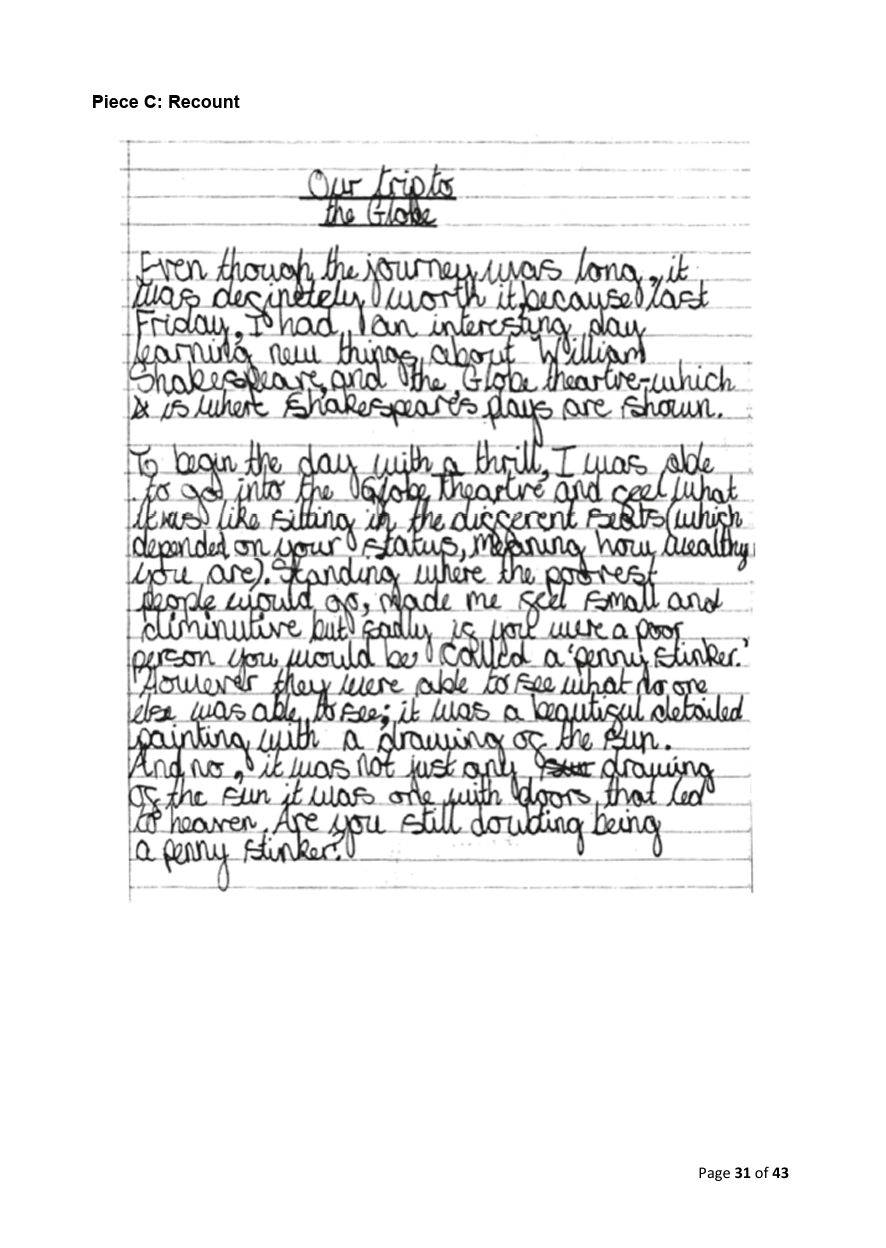
Our trip to the Globe
Even though the journey was long, it was definetely Teacher note: Check this Year 5/6 spelling: definitely. — GPS: Year 5/6 spellings worth it because last Friday, I had an interesting day learning new things about William Shakespeare, and the Globe theatre, which is where Shakespeares plays Teacher note: Use an apostrophe to show that the plays belong to Shakespeare. — GPS: Apostrophes and other punctuation are shown.
To begin the day with a thrill Teacher note: This time opener clearly guides your reader through the recount. — GPS: Cohesion through time adverbials and connectives, I was able to go into the Globe theatre and see what it was like sitting in the different seats (which depended on your status, meaning how wealthy you are). Standing where the poorest people would go, made me feel small and Teacher note: ILLEGIBLE but sadly, if you were a poor person you would be called a ‘penny stinker’ However, they were able to see what no one else was able to see; it was a beautiful detailed painting Teacher note: Your precise description helps the reader picture what you saw. — TAF: select vocabulary and grammatical structures that reflect what the writing requires, doing this mostly appropriately with a drawing of the sun. And no, it was not just any Crossed out: drawing of the sun, it was one with doors that led to heaven. Therefore, still considering being a penny stinker.
Page 31 of 43
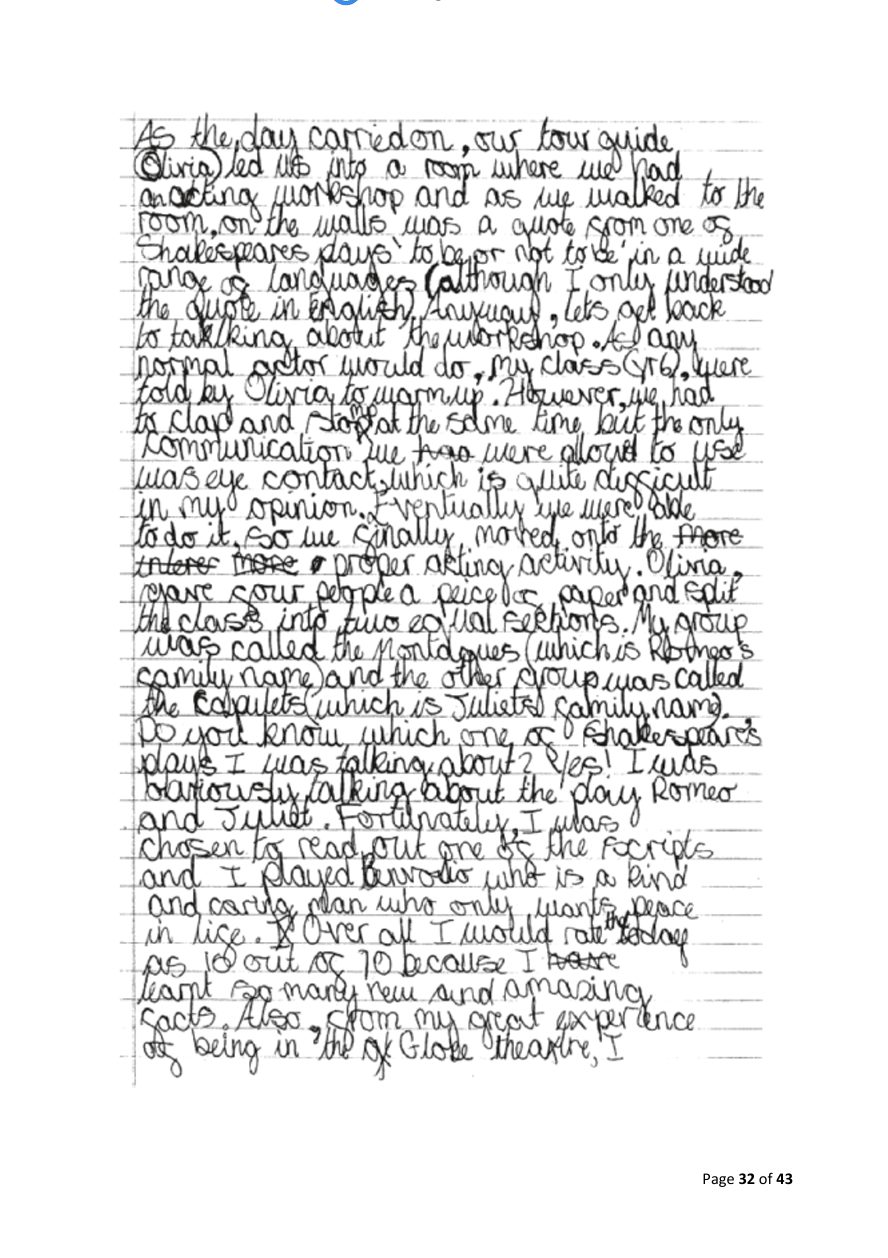
As the day carried on Teacher note: This linking phrase moves your recount smoothly to the next event. — GPS: Cohesion through time adverbials and connectives, our tour guide, Olivia, led us into a room where we had an acting workshop and as we walked to the room, on the walls was a quote from one of Shakespeare's plays "to be or not to be" in a wide range of languages. Although I only understand the english Teacher note: Remember the language name needs a capital letter: English. — TAF: use capital letters, full stops, question marks, commas for lists and apostrophes for contraction mostly correctly, in english, I was able to feel proud to talking about the workshop as any normal actor would do. My class (7T6), were told by Olivia, to warm up. However, we had to play and stop at the same time, but the only communication we were allowed to use was eye contact, which is quite difficult in my opinion. Eventually, we were able to do it. For the finale, Teacher note: ILLEGIBLE got to Crossed out: have there was one acting activity. Olivia, gave four people a piece of paper and split the class into two equal sections. My group was called the Montagues (which is Romeo's family name) and the other group was called the Capulets (which is Juliet's family name). Do you know which one of Shakespeare's plays I was talking about? Yes! I was obviously talking about the play Romeo and Juliet. Fortunately, I was chosen to read out one of the scripts and I played Benvolio who is a kind and caring man who only wants peace in life. Over all I would rate today as 10 out of 10 because I Crossed out: have learnt so many new and amazing facts. Also, from my great experience of being in the Globe theatre, I
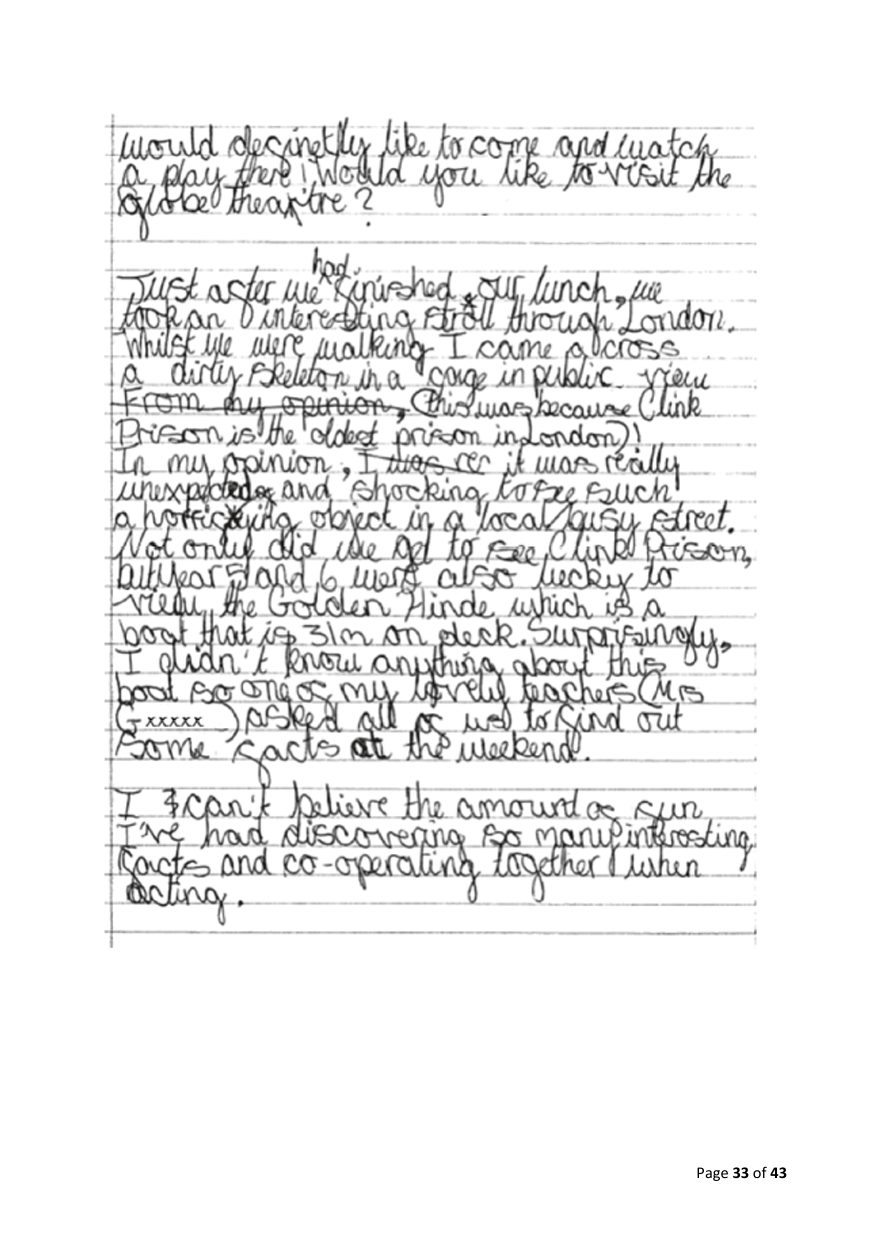
I would definitely like to come and watch a play there! Would you like to visit the Globe Theatre? Teacher note: Your question directly involves the reader at the end of this section. — TAF: write effectively for a range of purposes and audiences, selecting language that shows good awareness of the reader
Just after we finished our lunch Teacher note: This time phrase clearly signals the next part of your day. — GPS: Cohesion through time adverbials and connectives, we took an interesting stroll through London. Whilst we were walking I came across Teacher note: This subordinate opener adds detail about when the event happened. — GPS: Complex sentences and subordination a dusty shelter with a cage in public. You Crossed out: now Teacher note: ILLEGIBLE the Clink Prison is the oldest prison in London)! In my opinion, I thought it was really unexpected and shocking Teacher note: These evaluative words show clearly how the discovery made you feel. — GPS: Reader-aware and evaluative language to see such a horrific project in a local busy street. Not only did we get to see Clink Prison, but we Teacher note: ILLEGIBLE also lucky to visit the Golden Hinde which is a boat that is 31m on deck. Surprisingly, I didn't know anything about this boat so since my friend, Mrs (xxxxx) asked all of us to find out some facts at the weekend.
I can't believe the amount of fun I've had discovering so many interesting facts and co-operating together! When boating. Teacher note: Finish this idea as a complete sentence so your ending is clear. — GPS: Sentence demarcation
The improved version — read it straight through, then see what changed
Even though the journey was long, it was To begin the day with a thrill, I entered the Globe Theatre and saw what it was like to sit in the different seats, which depended on your status, meaning how wealthy you were. Standing where the poorest people would go made me feel small; of the sun. still considering being a penny stinker!
As the day carried on, our tour guide, Olivia, led us in a wide range of languages. Although I only quite difficult, in my opinion. Eventually, we were able to do it. For the finale, there was an acting activity: Olivia gave four people a piece of paper and split the class into two equal sections. My group was called the Montagues, which is Romeo's family name, and the other group was called the Capulets, which is Juliet's family name. Do you know which of Shakespeare's plays I was talking about? Yes — obviously Romeo and Juliet! Fortunately, I was chosen to read one of the scripts, and I played Benvolio, a kind and caring man who only wants peace in life. and watch a play there. Would you like to visit the Globe Theatre?
Just after we finished our lunch, we took an interesting stroll through London. Whilst we were walking, I came across a dusty shelter with a cage: the oldest prison in London. I thought it was unexpected and shocking to see such a horrific place in a busy local street. Not only did we Mrs (xxxxx) asked all of us to find out some facts at the weekend. I cannot believe the amount of fun I had discovering so many interesting facts and co-operating together!
What changed and why
Mark your own piece of writing
Photograph a handwritten piece and get the same report — free to start, no card required.