STA 2018 KS1 Expected Standard
Piece E — Description
Year 2 · STA Expected Standard · Kim
Published exemplification — the same live marking as the product, on government or exam-board material, not a pupil’s book. STA KS1 English writing exemplification. Contains material developed by the Standards and Testing Agency for 2018 national curriculum assessments and licenced under Open Government Licence v3.0.
Published script
Live marked report
Working at the expected standard
This is a lively, coherent description of a dragon, with clear ideas and some good control of sentence linking. It is strongest when it builds the dragon’s powers through vivid detail, and it is close to the expected standard because it also shows some proof-reading and correction.
Strengths
You use imaginative descriptive phrases such as “fire dragon”, “rings of fire” and “the center of the sun”.
You link ideas with subordinating conjunctions, for example “If you make him angry” and “When he goes to sleep”.
You have noticed and corrected some spellings, shown by the crossings-out of “Wen” and “gose”.
Areas for Development
Capital letters and full stops are not yet secure in every sentence.
Some tricky words still need careful spelling, for example “breth”, “sisel”, “dinamite” and “any ting”.
A few punctuation choices are not quite right, such as the semi-colon in “When the flys; he lights up the sky”.
Next Steps
Read each sentence back and check that it starts with a capital letter and ends with a full stop or exclamation mark.
Composition
| Can-statement | Status | Evidence |
|---|---|---|
| writes a short, coherent descriptive piece with ideas sequenced clearly | Met | The writing stays focused on the dragon throughout: “My dragon is a fire dragon” and “He can also turn any ting into food”. |
| organises information so the reader can follow what the dragon looks like and can do | Met | The description moves from appearance and breath to powers and effects: “breth can make cars sisel like dinamite” and “make people catch fire and make things explode”. |
Vocabulary
| Can-statement | Status | Evidence |
|---|---|---|
| chooses descriptive words and phrases to create a clear image | Met | Phrases such as “fire dragon”, “rings of fire”, “lights up the sky” and “center of the sun” give the piece a vivid feel. |
| uses adventurous vocabulary for effect | Met | Words and phrases such as “explode”, “catch fire”, “turn things to Stone” and “throw you in the sun” make the dragon seem powerful and dangerous. |
grammar and punctuation
| Can-statement | Status | Evidence |
|---|---|---|
| uses some subordination to add detail | Met | The writing includes subordinate clauses such as “If you make him angry” and “When he goes to sleep”. |
| uses co-ordination to join ideas | Met | Co-ordination is shown in phrases such as “make people catch fire and make things explode”. |
| demarcates some sentences with capital letters and full stops | Partially met | There are some correctly separated sentences, but capitals are not consistent, for example “his breth...” and “he lights up...”. |
| uses punctuation taught at KS1 mostly correctly | Partially met | Full stops and an exclamation mark are used, but punctuation is not always secure, for example “When the flys; he lights up the sky”. |
Spelling
| Can-statement | Status | Evidence |
|---|---|---|
| segments spoken words into phonemes and represents them by graphemes | Met | Phonetic attempts such as “breth”, “sisel”, “dinamite”, “gose” and “any ting” show sound-by-sound spelling. |
| makes phonically plausible attempts at unfamiliar words | Met | Several unfamiliar words are attempted plausibly, including “breth”, “sisel”, “dinamite” and “flys”. |
| spells some common exception words | Partially met | Some common words are correct, such as “When”, “will”, “you” and “my”, but the evidence for secure Year 2 exception-word spelling is limited in this piece. |
Handwriting
| Can-statement | Status | Evidence |
|---|---|---|
| Handwriting (assessed from the original work) | Met | Large, lightly formed mixed-print handwriting with uneven spacing and size. |
Grammar, Punctuation & Spelling security assessment
Sentence structure
“If you make him angry, he will breath rings of fire at you.”
“When he goes to sleep the fire in the sun goesout.”
Subordinate clauses are used to add conditions and time links.
“make people catch fire and make things explode.”
“He can also turn any ting into food & When he gets angry he Will throw you in the sun!”
Ideas are joined with and, including within a list of powers.
Punctuation
“My dragon is a fire dragon. his breth can make cars sisel like dinamite.”
“He can turn things to Stone, make people catch fire and make things explode.”
Full stops are used, but capital letters and sentence control are inconsistent.
“If you make him angry, he will breath rings of fire at you.”
“He can also turn any ting into food & When he gets angry he Will throw you in the sun!”
An exclamation mark is used for impact; punctuation is varied and uneven.
Spelling
“breth”
“sisel”
“dinamite”
“flys”
“gose”
Several inventive spellings show sound-by-sound attempts at unfamiliar words.
Editing
“[crossed out: Wen] When”
“[crossed out: gose] goes”
There is clear evidence of re-reading and correcting some spellings.
Vocabulary
“fire dragon”
“rings of fire”
“lights up the sky”
“center of the sun”
“turn things to Stone”
The vocabulary creates a vivid, powerful image of the dragon.
The original writing, exactly as written, with the teacher notes marked
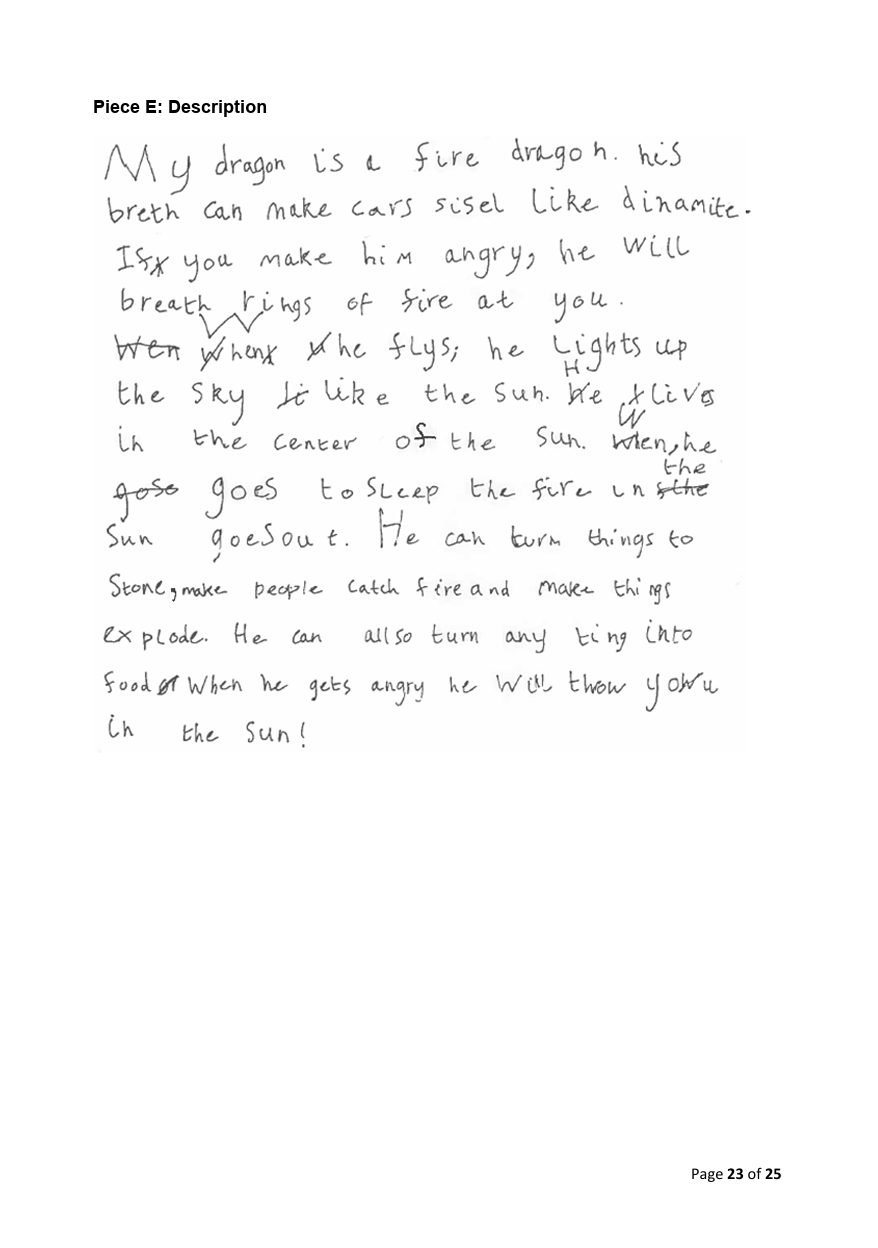
Piece E: Description
My dragon is a fire dragon Teacher note: Your descriptive phrase helps the reader picture your dragon.. his Teacher note: Start this new sentence with a capital letter. breth can make cars sisel like dinamite. If you make him angry Teacher note: You use “If” to add detail about the dragon., he will breath rings of fire at you. Crossed out: Wen When Teacher note: You spotted a spelling and corrected it yourself. the flys; Teacher note: Use a comma or full stop here, not a semicolon. he lights up the sky it like the sun. he lives in the center of the sun. When he Crossed out: gose goes Teacher note: You checked and corrected this spelling. to sleep the fire in the sun goesout. He can turn things to Stone, make people catch fire and make things explode Teacher note: You join actions together clearly using “and”.. He can also turn any ting Teacher note: Write this as one word: “anything”. into food & When he gets angry he Will throw you in the sun!
The improved version — read it straight through, then see what changed
My dragon is a fire dragon. His If you make him angry, he will rings of fire at you. When like the sun, of the sun. When he goes to sleep, the fire in the sun He can turn things to , make people catch fire and make things explode. He can also turn the sun!
What changed and why
Mark your own piece of writing
Photograph a handwritten piece and get the same report — free to start, no card required.