STA 2018 KS1 Expected Standard
Piece C — Narrative
Year 2 · STA Expected Standard · Kim
Published exemplification — the same live marking as the product, on government or exam-board material, not a pupil’s book. STA KS1 English writing exemplification. Contains material developed by the Standards and Testing Agency for 2018 national curriculum assessments and licenced under Open Government Licence v3.0.
Published script
Live marked report
Working towards the expected standard
Fred's adventure is clear and engaging, with a simple beginning, problem and ending. It matches the kind of short sequenced narrative seen in the WTS exemplification, but the control of punctuation and sentence joining is not yet secure enough for the expected standard .
Strengths
The story is sequenced clearly: 'Meet Fred...', 'Fred went into the attic' and 'From that day on Fred used his machine everyday'.
There is a purposeful narrative idea with a problem and solution: Fred finds the parts, the machine 'went boom', and then he fixes it.
Some descriptive touches help the reader, such as 'It was really dark in the attic' and 'a silver case'.
The writing includes phonetic attempts at tricky words, for example 'board', 'hols', 'foor' and 'puged'.
Areas for Development
Use capital letters and full stops more consistently, especially at the start of sentences and around direct speech.
Join ideas with a wider range of sentence structures, including clearer subordination and more controlled coordination.
Check common word spellings such as 'bored', 'downstairs', 'plugged' and 'everything'.
Proofread to remove crossed-out or unfinished wording where possible.
Next Steps
After writing, read each sentence aloud and check: does it start with a capital letter and end with a full stop?
Practise rewriting the story in 5 or 6 clear sentences, using one 'because' or 'when' sentence to join ideas.
Composition
| Can-statement | Status | Evidence |
|---|---|---|
| Write sentences that are sequenced to form a short narrative. | Met | The piece has a clear storyline with a beginning, middle and ending: 'Meet Fred... one day...', 'Fred went into the attic', and 'From that day on Fred used his machine everyday'. |
| Make simple additions, revisions and corrections to their own writing. | Partially met | There are some visible changes, for example 'crossed out: toot', 'crossed out: Soon' and 'crossed out: the', but the revision work is limited. |
| Write for different purposes / show broader control across writing. | Not met | This response is a single fictional narrative rather than a wider range of purposes. |
Vocabulary
| Can-statement | Status | Evidence |
|---|---|---|
| Choose words that help the reader picture the story. | Partially met | Words such as 'really dark', 'silver case', 'caught his eye' and 'machine' help build the scene. |
| Use vocabulary to create some effect for the reader. | Partially met | The build-up to 'the machine went boom' gives the story a simple sense of drama. |
| Draw on a wider range of vocabulary from reading. | Not met | Most wording is straightforward and everyday, with limited ambitious vocabulary. |
Grammar and punctuation
| Can-statement | Status | Evidence |
|---|---|---|
| Demarcate some sentences with capital letters and full stops. | Partially met | Many sentences are clearly marked, e.g. 'Fred went into the attic. It was really dark in the attic.' |
| Use a range of sentence forms and join ideas with some co-ordination and subordination. | Partially met | There is some co-ordination in 'Fred was sad. So he went to the garage...' and 'and then', but subordination is limited. |
| Use capital letters for names and the pronoun I. | Partially met | 'Fred' and 'I' are sometimes capitalised, but there are many inconsistent capitals such as 'Said', 'GO Into THe Attic' and 'At First'. |
| Use punctuation taught at key stage 1 mostly correctly. | Not met | The piece relies mainly on full stops; speech marks and other punctuation are not controlled securely. |
Spelling
| Can-statement | Status | Evidence |
|---|---|---|
| Segment spoken words into phonemes and represent these by graphemes, making phonically plausible attempts at some words. | Partially met | Examples include 'board', 'hols', 'foor', 'puged', 'every thing' and 'thought'. |
| Spell some common exception words correctly. | Partially met | Common words such as 'one', 'said', 'his', 'into', 'from' and 'day' are mostly correct. |
| Spell most common exception words / use suffixes securely. | Not met | There are several inaccurate spellings of familiar words, including 'bored', 'downstairs', 'plugged' and 'everything'. |
Handwriting
| Can-statement | Status | Evidence |
|---|---|---|
| Handwriting (assessed from the original work) | Met | Large mixed cursive and print letters with variable spacing and occasional overwriting.; Cursive-style writing is generally readable but has uneven spacing and frequent overwriting. |
Grammar, Punctuation & Spelling security assessment
Sentence Structure
“Meet Fred. Fred loves to find things.”
“Fred went into the attic.”
“From that day on Fred used his machine everyday”
Events are ordered chronologically with a clear opening, problem and resolution.
Grammar
“Fred went into the attic.”
“Fred was sad.”
“he had finish writing every thing down”
The narrative is mainly in the past tense.
Punctuation
“Meet Fred. Fred loves to find things.”
“Fred was sad. So he went to the garage got some tools”
“From that day on Fred used his machine everyday”
Many sentences are clearly separated, though consistency varies.
“"The computer said DELL.”
There is an attempt at speech punctuation, but it is not fully controlled.
Spelling
“board”
“hols”
“foor”
“puged”
“every thing”
Several words are spelled in a phonetic way that shows sound-by-sound attempts.
“one day”
“said”
“into”
“from”
“his”
Many common words are correct, although some familiar spellings are inaccurate.
Vocabulary
“really dark in the attic”
“a silver case”
“caught his eye”
“the machine went boom”
The wording is simple but purposeful and helps the reader follow the story.
The original writing, exactly as written, with the teacher notes marked
Piece C: Narrative
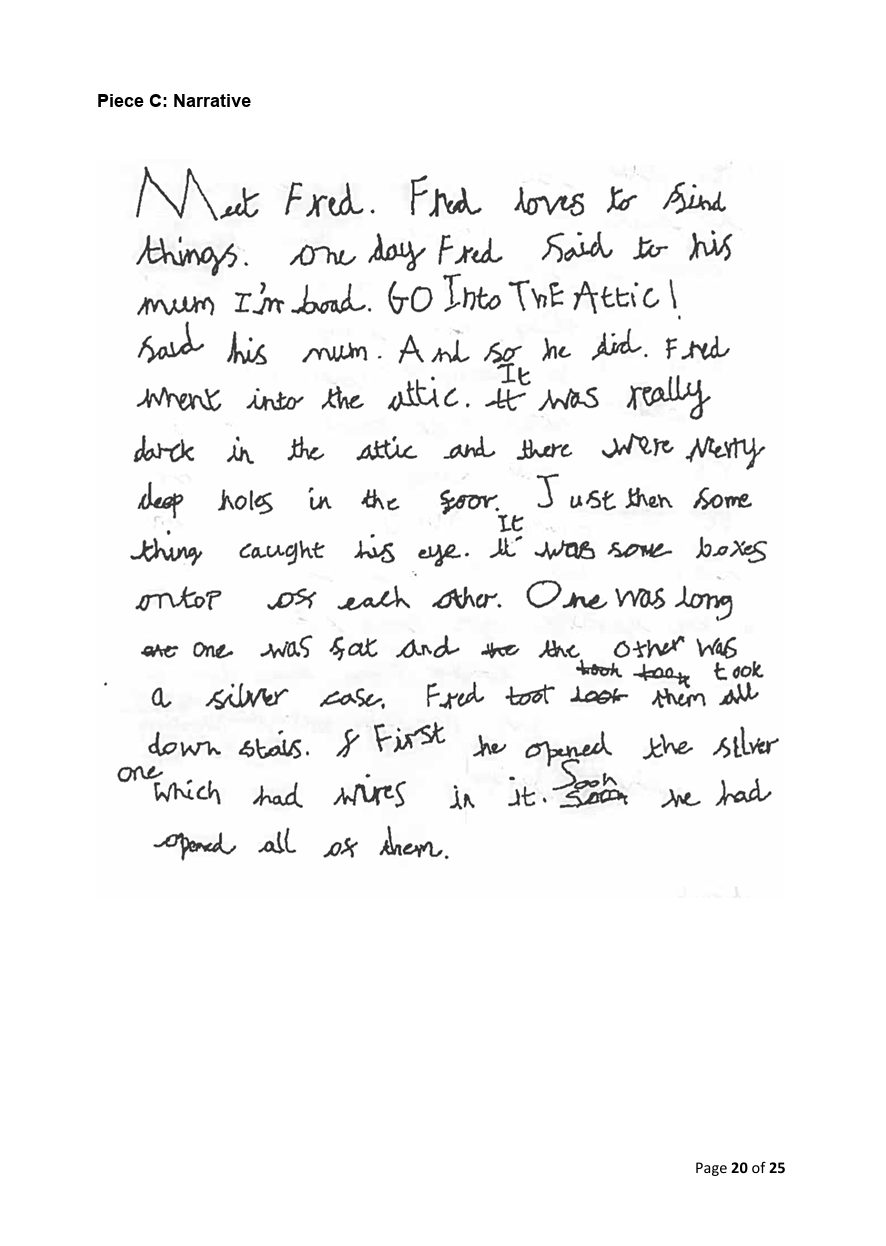
Meet Fred. Fred loves to find things. Teacher note: Your story has a clear beginning, middle and ending. one day Fred Said to his mum I’m board. Teacher note: Start this new sentence with a capital letter. GO Into THe Attic! said his mum. And so he did. Fred went into the attic. It was really dark in the attic Teacher note: This detail helps me picture the attic. and there were Plenty deep hols in the foor. Teacher note: Your sounds help you spell these tricky words. Just then Some thing caught his eye. It was some boxes on top of each other. One was long and one was fat and Crossed out: the the other was a silver case. Teacher note: Silver tells me what the case looks like. Fred Crossed out: toot took Teacher note: You spotted and corrected a word yourself. them all down stairs. At First he opened the silver one Which had wires in it. Crossed out: Soon he had opened all of them.
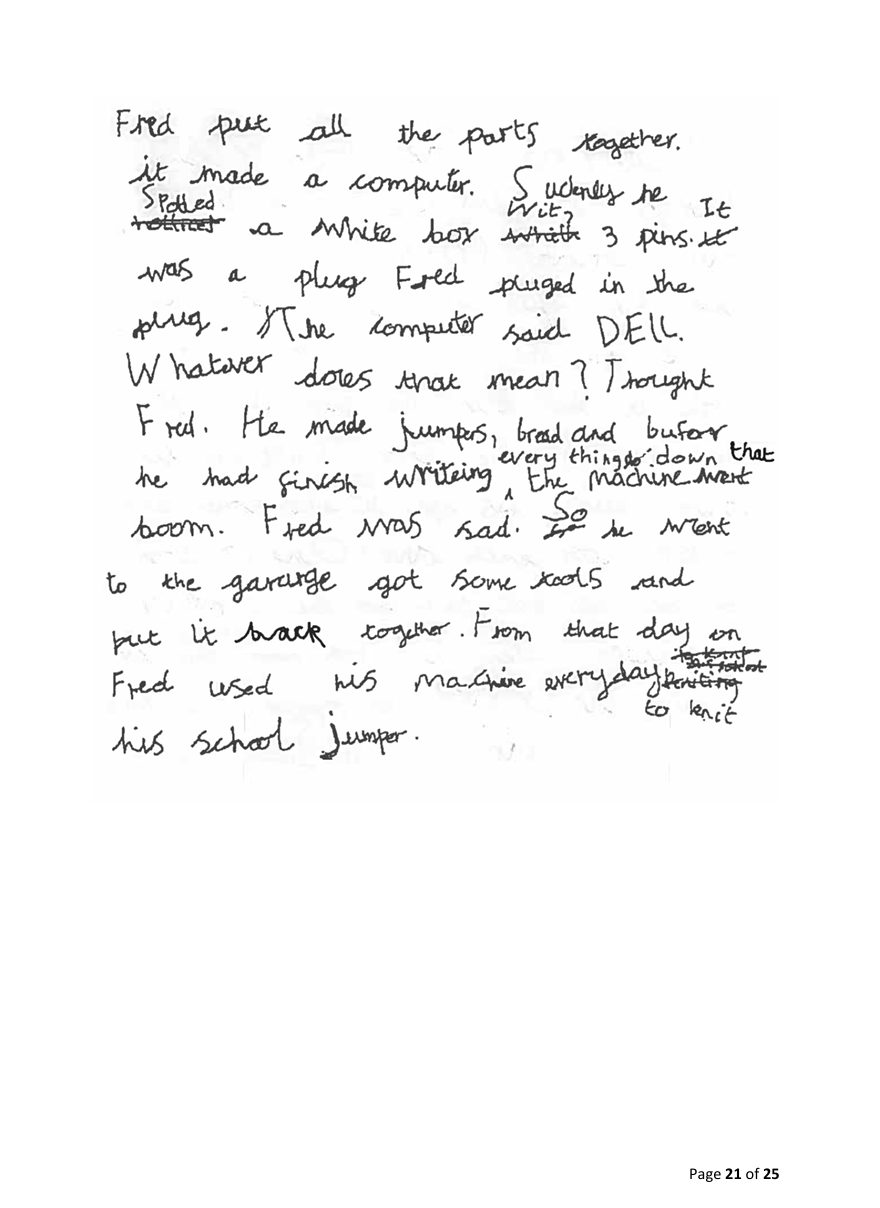
Fred put all the parts together. it made a computer. Teacher note: ILLEGIBLE he Soldered Crossed out: [ILLEGIBLE] a white box Crossed out: with 3 pins. it was a plug Fred puged Teacher note: Your sounds help you spell this tricky word. in the plug. "The computer said DELL. Teacher note: Use speech marks around everything the computer says. What ever does that mean? Thought Fred. He made jumpers, brad and bufor, he had finish writing every thing Teacher note: Write "everything" as one word. down that the machine went boom. Fred was sad. So he went to the garage got some tools and put it back together. From that day on Fred used his machine everyday Teacher note: Check this word: it is usually spelled "every day" here. Crossed out: knitting to knit his school jumper.
The improved version — read it straight through, then see what changed
Meet Fred, things. One day, Fred said to his mum, “I’m so he did. In the really dark attic, there were plenty of deep holes in the floor when something caught Fred’s eye: one was fat and the other was a silver case. Fred took them all Fred put all the parts together “The computer said, ‘DELL.’ does that mean?” thought Fred; the machine went boom, to knit his school jumper.
What changed and why
Mark your own piece of writing
Photograph a handwritten piece and get the same report — free to start, no card required.