STA 2018 KS1 Expected Standard
Piece B — Description
Year 2 · STA Expected Standard · Kim
Published exemplification — the same live marking as the product, on government or exam-board material, not a pupil’s book. STA KS1 English writing exemplification. Contains material developed by the Standards and Testing Agency for 2018 national curriculum assessments and licenced under Open Government Licence v3.0.
Published script
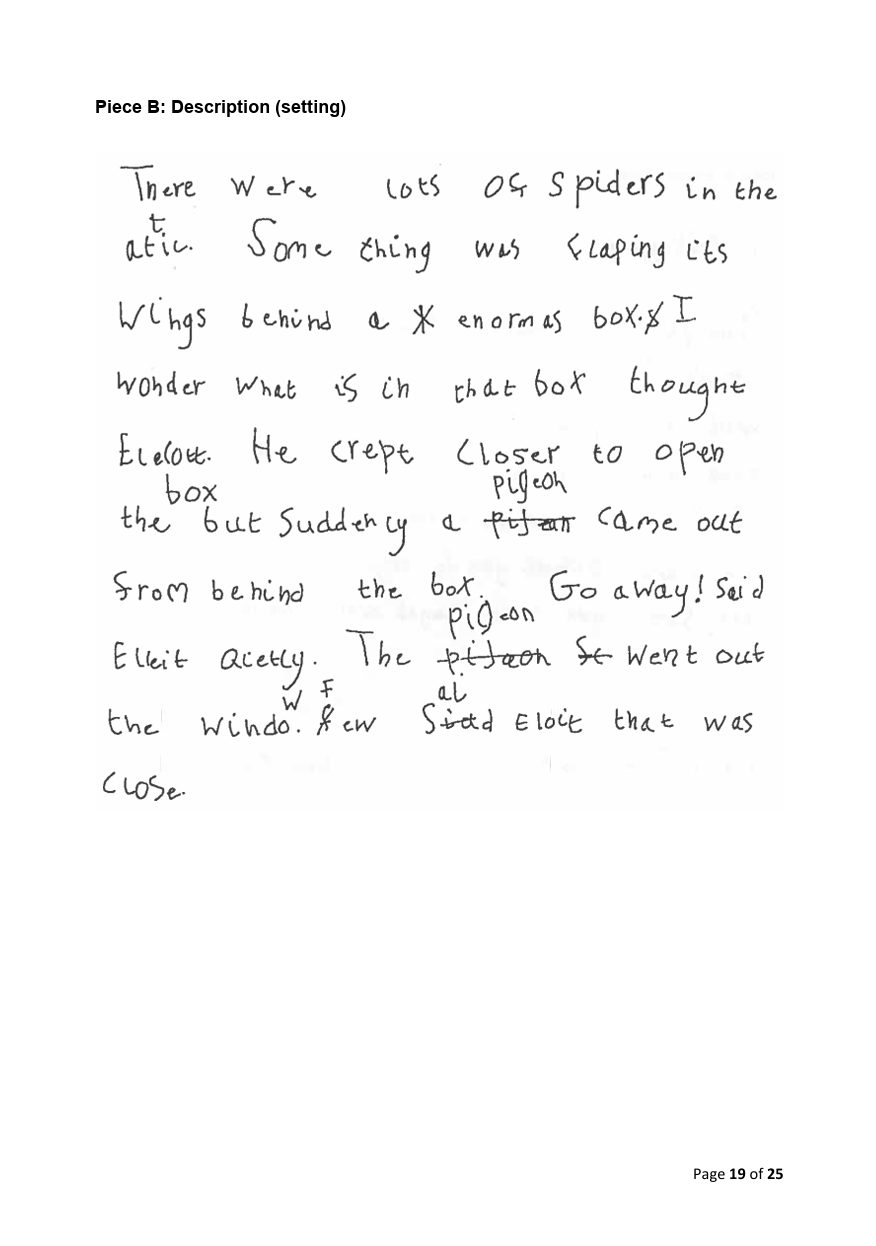
Live marked report
Working at the expected standard
You have written a lively little attic scene and you keep the reader wondering what is behind the box. The piece is stronger than working towards because it is coherent and mostly in the past tense, but it still needs more secure sentence demarcation and spelling to match the expected standard consistently, especially when compared with the expected-standard and working-towards exemplification.
Strengths
You build atmosphere right from the start with 'There were lots of spiders in the attic' and 'an enormous box'.
You create suspense well by moving the action on from 'He crept closer' to 'a pigeon ... came out' and then 'He went out the window'.
You also use some effective dramatic language, for example 'Suddenly' and 'Go away!'.
Areas for Development
Some sentence boundaries need tightening, especially where speech and action run together, such as 'Go away! Said Eloit quietly.'
A few common spellings need checking, such as 'claping', 'Some thing' and the name 'Eloiet/Eloit'.
You could make the setting even clearer by adding a little more detail about what the attic looked or felt like.
Next Steps
Practise writing one sentence at a time with a capital letter and a full stop, then read it aloud to check it sounds finished.
Composition
| Can-statement | Status | Evidence |
|---|---|---|
| write sentences that are sequenced to form a short narrative (real or fictional) | Met | The action is sequenced clearly: 'There were lots of spiders in the attic' ... 'He crept closer to open the box' ... 'came out from behind the box' ... 'He went out the window'. |
| write simple, coherent narratives about personal experiences and those of others (real or fictional) | Partially met | The scene is coherent and purposeful, but it is very brief and reads more like a short snapshot than a fully developed narrative. |
| write about real events, recording them simply and clearly | Not met | This is a fictional scene, not a recount of a real event. |
Vocabulary
| Can-statement | Status | Evidence |
|---|---|---|
| write effectively and coherently for different purposes, drawing on their reading to inform the vocabulary and grammar of their writing | Not met | There is some descriptive vocabulary, such as 'lots of spiders', 'enormous box' and 'quietly', but not the breadth or control seen in the greater-depth exemplification. |
Grammar and punctuation
| Can-statement | Status | Evidence |
|---|---|---|
| demarcate most sentences in their writing with capital letters and full stops, and use question marks correctly when required | Partially met | Some sentences are marked with capitals and full stops, but the demarcation is not secure throughout; no question mark is used. |
| use present and past tense mostly correctly and consistently | Partially met | Past tense dominates with 'were', 'was', 'crept', 'came' and 'went', but there are slips such as 'I wonder what is in that box'. |
| use co-ordination (such as or/and/but) and some subordination (such as when/if/that/because) to join clauses | Partially met | Co-ordination appears in 'but' and 'and', but subordination is limited and not securely controlled. |
Spelling
| Can-statement | Status | Evidence |
|---|---|---|
| segment spoken words into phonemes and represent these by graphemes, spelling some words correctly and making phonically plausible attempts at others | Met | The spelling shows clear sounding-out, for example 'claping', 'Eloiet' and 'Eloit', alongside correct words such as 'attic', 'behind' and 'window'. |
| segment spoken words into phonemes and represent these by graphemes, spelling many of these words correctly and making phonically plausible attempts at others | Partially met | There are phonically plausible attempts, but spelling is not yet accurate enough across the piece to be secure at the expected standard. |
| spell many common exception words | Partially met | Some common words are correct, but others are insecure, for example 'Some thing' and 'Said'. |
| Can-statement | Status | Evidence |
|---|
| Can-statement | Status | Evidence |
|---|
| Can-statement | Status | Evidence |
|---|
| Can-statement | Status | Evidence |
|---|
| Can-statement | Status | Evidence |
|---|
| Can-statement | Status | Evidence |
|---|
| Can-statement | Status | Evidence |
|---|
| Can-statement | Status | Evidence |
|---|
| Can-statement | Status | Evidence |
|---|
Handwriting
| Can-statement | Status | Evidence |
|---|---|---|
| Handwriting (assessed from the original work) | Met | Large, uneven printed letters with variable spacing and several corrections. |
The original writing, exactly as written, with the teacher notes marked
Piece B: Description (setting)
There were lots of spiders in the attic. Teacher note: This opening introduces an attic setting and starts your story clearly. Some thing Teacher note: Write this compound word as one word: something. was claping Teacher note: Check this spelling: clapping needs two p letters. its Wings behind a * enormous box I wonder what is in that box thought Eloiet. Teacher note: Add punctuation to show where Eloiet's thought begins and ends. He crept closer to open the box but Suddenly a pigeon Crossed out: pigeon came out Teacher note: You use but to join the actions and build suspense. from behind the box. Go away! Teacher note: The shouted words make this moment feel dramatic. Said Eloit quietly. Teacher note: Start a new sentence correctly after the speech. The Crossed out: pigeon He went out the window. Few Said Eloit that was close.
The improved version — read it straight through, then see what changed
There were lots of spiders in the attic. its wings behind enormous box. “I wonder what is in that box,” thought a pigeon came out from behind The the window. said Eloit. “That was close.”
What changed and why
Mark your own piece of writing
Photograph a handwritten piece and get the same report — free to start, no card required.