STA 2018 KS1 Expected Standard
Piece A — Explanation
Year 2 · STA Expected Standard · Kim
Published exemplification — the same live marking as the product, on government or exam-board material, not a pupil’s book. STA KS1 English writing exemplification. Contains material developed by the Standards and Testing Agency for 2018 national curriculum assessments and licenced under Open Government Licence v3.0.
Published script
Live marked report
Working at the expected standard
You have written a clear, purposeful set of instructions about the machine, and the reader can follow the steps easily. Your writing is close to the STA expected-standard example because the ideas are sequenced well and you use simple clause-joining words effectively .
Strengths
You organise the steps clearly, for example 'You plug in the machine. Than you switch it on.'
You use helpful sequencing words such as 'Before you do anything' and 'Then'.
Your spelling shows sound-based attempts, such as 'Maltey', 'buton' and 'hapening'.
Areas for Development
Some sentence boundaries need more control, especially where capital letters and full stops are uneven.
A few common words need checking, for example 'Than' should be 'Then'.
Try to make the explanation more precise by naming the machine parts more clearly.
Next Steps
Practise writing 3 short instruction sentences, with one idea in each sentence, then read them aloud to check the capitals, full stops and spellings.
Composition
| Can-statement | Status | Evidence |
|---|---|---|
| write effectively and coherently for different purposes | Partially met | The piece has a clear purpose and a logical sequence, but the range of ideas is narrow and the language is simple. |
| make simple additions, revisions and proof-reading corrections to their own writing | Partially met | There is some evidence of checking and changing, but only limited revision is visible in this short piece. |
Vocabulary
| Can-statement | Status | Evidence |
|---|---|---|
| choose vocabulary appropriate to the purpose | Met | Words such as 'plug', 'switch', 'machine' and 'TV box' fit the task, and 'bleep, buz, bleep' adds effect. |
| draw on reading to inform vocabulary and grammar | Partially met | The language is clear and task-related, but not especially varied or reading-informed. |
grammar and punctuation
| Can-statement | Status | Evidence |
|---|---|---|
| demarcate most sentences with capital letters and full stops | Partially met | There are several correctly marked sentences, for example 'You plug in the machine.' and 'Than you switch it on.', but capital letters are not yet consistent. |
| use co-ordination and some subordination to join clauses | Met | 'and then' and 'Before you do anything' join ideas effectively. |
| use the punctuation taught at KS1 mostly correctly | Partially met | Full stops are used, but capitalisation and internal punctuation are uneven. |
Spelling
| Can-statement | Status | Evidence |
|---|---|---|
| segment spoken words into phonemes and represent these by graphemes, spelling many words correctly and making phonically plausible attempts at others | Met | 'Maltey', 'tast', 'buton', 'key bord', 'pluged' and 'hapening' show phonetic spelling. |
| spell many common exception words | Partially met | Some common words are correct, but 'Than' for 'Then' shows this is not yet secure. |
Handwriting
| Can-statement | Status | Evidence |
|---|---|---|
| Handwriting (assessed from the original work) | Met | Large, uneven mixed print with variable spacing and some overwritten corrections. |
Grammar, Punctuation & Spelling security assessment
Sentence structure
“You plug in the machine. Than you switch it on.”
Ideas are organised in a clear step-by-step order.
“and then”
“Before you do anything”
Joining words connect the steps and add sequence.
Punctuation
“You plug in the machine. Than you switch it on.”
Several sentence stops are marked clearly.
“Then Switch on the Tv box So You can wach every thing that is hapening inside the machine.”
Capitalisation is inconsistent across the piece.
Spelling
“Maltey”
“tast”
“buton”
“key bord”
“pluged”
“wach”
“hapening”
Words are attempted using sound-based spellings.
“you”
“the”
“before”
“anything”
Many common words are correct, though 'Than' for 'Then' is not secure.
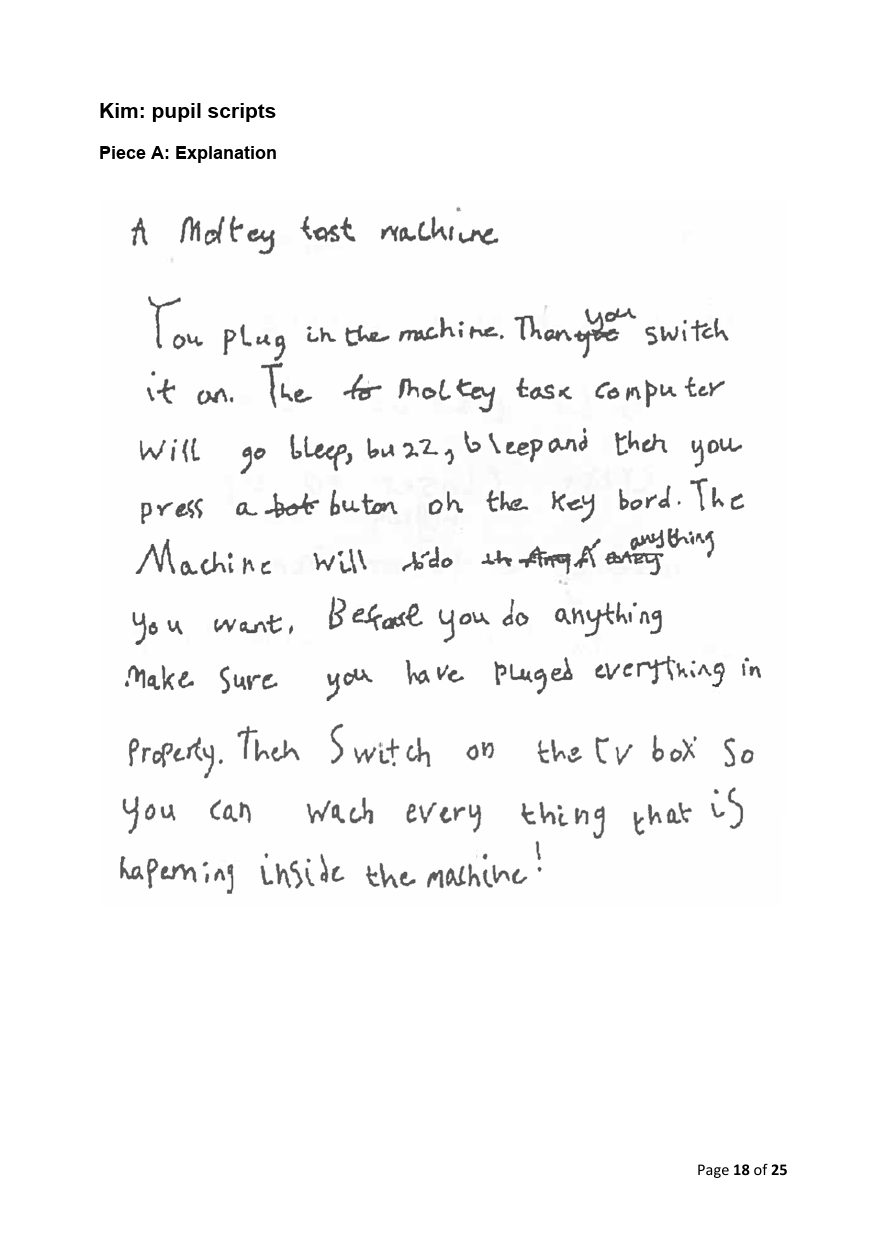
The original writing, exactly as written, with the teacher notes marked
Kim: pupil scripts
Piece A: Explanation
A Maltey tast machine Teacher note: Your title tells the reader what the explanation is about.
You plug in the machine. Teacher note: You begin with a clear first instruction. Than Teacher note: Check this common word: write 'Then' for the next step. you switch it on. The to Maltey task computer will go bleep, buz, bleep and then Teacher note: You join ideas using 'and then' successfully. you press a bot buton on the key bord. Teacher note: You use sound-based spelling attempts for machine parts. The Machine will do it Crossed out: thing anything Teacher note: You changed a word to improve your writing. you want, Before you do anything Make Teacher note: Add a full stop before this new instruction. sure you have pluged Teacher note: Your spelling shows the sounds you can hear. everything in Properly. Then Switch Teacher note: Use lower-case letters for 'switch' within this sentence. on the Tv box So You can wach every thing that is hapening inside the machine.
Page 18 of 25
The improved version — read it straight through, then see what changed
A Maltey Machine
switch it on, and the bleep”. anything you want. Before you do anything everything in properly. Then switch on the TV box so you can inside the machine.
What changed and why
Mark your own piece of writing
Photograph a handwritten piece and get the same report — free to start, no card required.