STA 2018 KS1 Expected Standard
Piece D — Instructions
Year 2 · STA Expected Standard · Kim
Published exemplification — the same live marking as the product, on government or exam-board material, not a pupil’s book. STA KS1 English writing exemplification. Contains material developed by the Standards and Testing Agency for 2018 national curriculum assessments and licenced under Open Government Licence v3.0.
Published script
Live marked report
Working at the expected standard
This is a purposeful piece with a clear audience and a sensible sequence of instructions. The opening and closing make it feel like a friendly letter, and the writer has also shown a good habit of revising and correcting parts of the text as they go.
Strengths
The instructions are easy to follow because they are ordered clearly, for example: 'First', 'Next' and 'Now'.
The piece is framed as a letter to Elliott, with 'Dear Elliott' at the start and 'love from ... xxx' at the end.
There is evidence of re-reading and correcting, such as '[crossed out: your] you' and '[crossed out: end] end'.
Areas for Development
Capital letters and full stops need to be used more consistently across the piece, especially at the start of sentences.
Some common words need checking, for example 'typ writer', 'cant' and 'any thing'.
The closing section could be made clearer by finishing the final sentence more cleanly.
Next Steps
Read the piece back and add any missing capital letters and full stops.
Practise spelling common words such as 'can't', 'anything' and 'typewriter'.
Keep writing short, clear steps using time connectives such as 'First', 'Next' and 'Now'.
Composition
| Can-statement | Status | Evidence |
|---|---|---|
| write effectively and coherently for different purposes, drawing on their reading to inform the vocabulary and grammar of their writing | Partially met | The piece is organised for a clear purpose, with a letter opening, a set of numbered instructions and a closing: 'Dear Elliott' ... 'How to use it:' ... 'love from ... Now you can typ letters to me.' |
| make simple additions, revisions and proof-reading corrections to their own writing | Met | There is visible correction within the text, for example '[crossed out: your] you', '[crossed out: end] end' and '[crossed out: of]'. |
Vocabulary
| Can-statement | Status | Evidence |
|---|---|---|
| draw on their reading to inform the vocabulary and grammar of their writing | Partially met | The writer uses purposeful task words such as 'typewriter', 'paper', 'lever', 'backspace' and 'ding', which fit the instructions well and help the reader picture the machine. |
| use vocabulary chosen to suit the purpose and audience | Met | The address to 'Elliott' and the friendly sign-off 'love from ... xxx' make the writing suitable for the intended reader. |
Grammar and punctuation
| Can-statement | Status | Evidence |
|---|---|---|
| demarcate most sentences in their writing with capital letters and full stops, and use question marks correctly when required | Partially met | Some sentence demarcation is present, but there are many places where it is not secure, for example 'Dear Elliott We know what you machine is it's a typewriter'. |
| use co-ordination (e.g. or / and / but) and some subordination (e.g. when / if / that / because) to join clauses | Partially met | There is some joining of ideas, for example 'If you hear a ding that means you are at the end of the line' and 'If you made a mistake!'. |
| use the punctuation taught at key stage 1 mostly correctly | Not met | The piece includes some punctuation such as exclamation marks in 'ding! ding!', but full stops, capitals and apostrophes are not used consistently. |
Spelling
| Can-statement | Status | Evidence |
|---|---|---|
| segment spoken words into phonemes and represent these by graphemes, spelling many of these words correctly and making phonically-plausible attempts at others | Partially met | Many words are spelled plausibly and correctly, including 'typewriter', 'lever', 'mistake' and 'silver', alongside phonetic attempts such as 'typ', 'cant' and 'any thing'. |
| spell many common exception words | Partially met | Words such as 'you', 'what', 'hear' and 'learn' are correct, but some common words are insecure, for example 'cant' and 'any thing'. |
| add suffixes to spell most words correctly in their writing (e.g. –ment, –ness, –ful, –less, –ly) | Not met | There is not clear evidence of secure suffix spelling in this piece. |
Handwriting
| Can-statement | Status | Evidence |
|---|---|---|
| Handwriting (assessed from the original work) | Met | Large mixed print has uneven spacing and variable letter sizes. |
Grammar, Punctuation & Spelling security assessment
Sentence structure
“1. First put the paper in the typ writer.”
“3. Next push the keys down to print a letter”
The steps are ordered and linked to the task.
Grammar and punctuation
“If you hear a ding that means you are at the end of the line”
“If you made a mistake!”
Conditional openings and clause linking are present.
Punctuation
“Dear Elliott We know what you machine is it's a typewriter”
“Now push the silver lever down on the side of the typewriter”
Capital letters and full stops are inconsistent.
“ding! ding!”
“How to use it:”
Exclamation marks and list numbering are used to support the format.
Spelling
“typ writer”
“cant”
“any thing”
Several attempts are sound-by-sound plausible.
“you are at the end of the line”
“I hope you learn how to use your typewriter”
Some common words are secure; others are not.
Vocabulary
“typewriter”
“silver lever”
“backspace”
Specific nouns and verbs match the subject matter.
The original writing, exactly as written, with the teacher notes marked
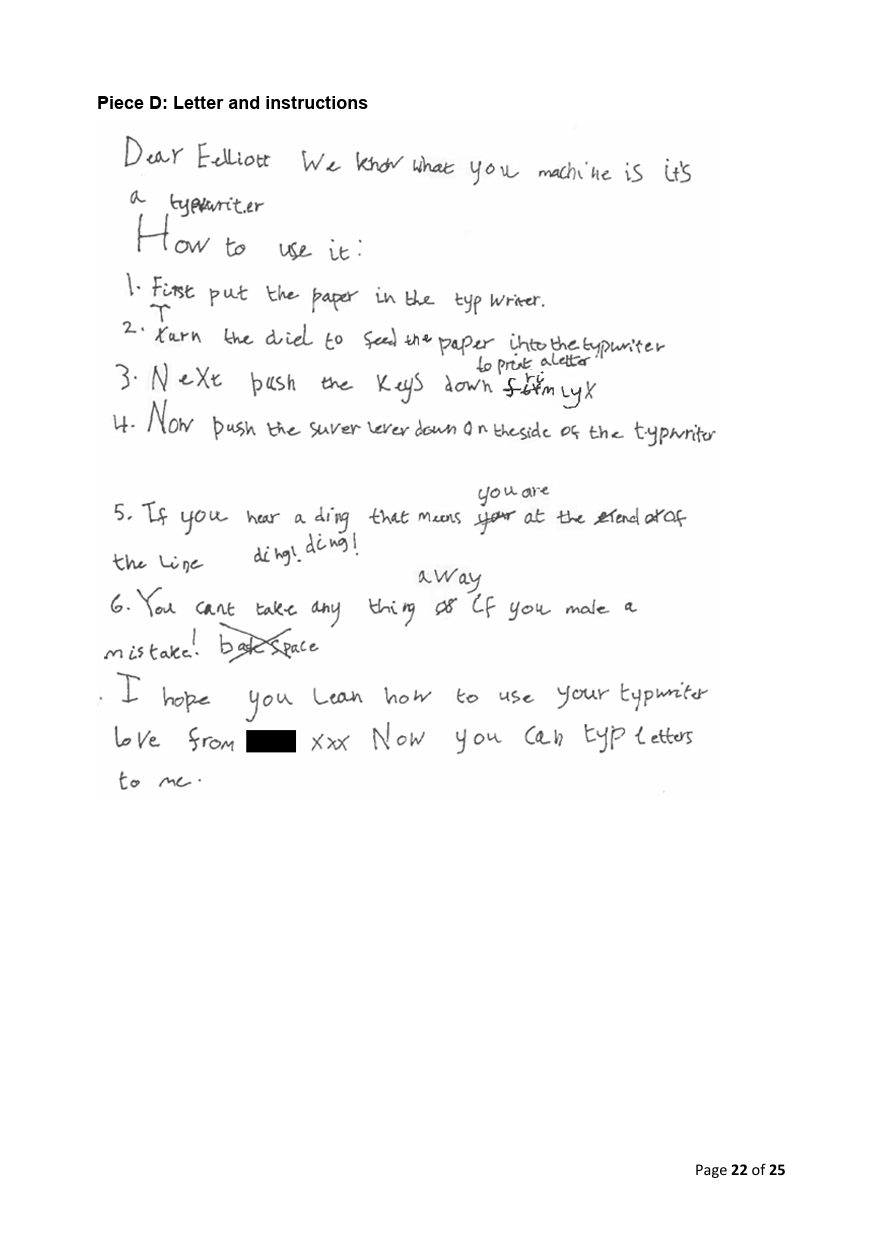
Piece D: Letter and instructions
Dear Elliott Teacher note: You begin clearly as a letter to Elliott. We know what you machine is it's Teacher note: Start each sentence with a capital letter and finish it with a full stop. a typewriter
How to use it: Teacher note: Your heading clearly introduces the instructions.
1. First put the paper in the typ writer. Teacher note: You use ‘First’ to put your instructions in order. 2. Turn the dial to feed the paper into the typewriter 3. Next push the keys down to print a letter 4. Now push the silver lever Teacher note: ‘silver lever’ is a precise word for this part. down on the side of the typewriter
5. If you hear a ding that means Crossed out: your you Teacher note: You have re-read and corrected this word. are at the Crossed out: end end of the line ding! ding! 6. You cant take any thing Teacher note: Check these common words: write ‘can’t’ and ‘anything’. Crossed out: of away If you made a mistake! Crossed out: backspace
. I hope you learn how to use your typewriter love from Teacher note: ILLEGIBLE xxx Now you can typ letters Teacher note: Finish the last sentence clearly, using a capital letter and full stop. to me.
The improved version — read it straight through, then see what changed
Dear Elliott,
We know what a typewriter.
How to use it:
1. First, put the paper in the 2. 3. 4. 5. If you hear a ding, means you are at the end of the line: ding! ding! 6. You
letters to me.
What changed and why
Mark your own piece of writing
Photograph a handwritten piece and get the same report — free to start, no card required.