Faster, clearer feedback for handwritten GCSE subjects
Photograph a handwritten answer. Get proposed marks against the paper and question, and a next step you can teach. In class marking, a teacher confirms or overrides every mark before pupils see it.
From a photographed answer to the next lesson
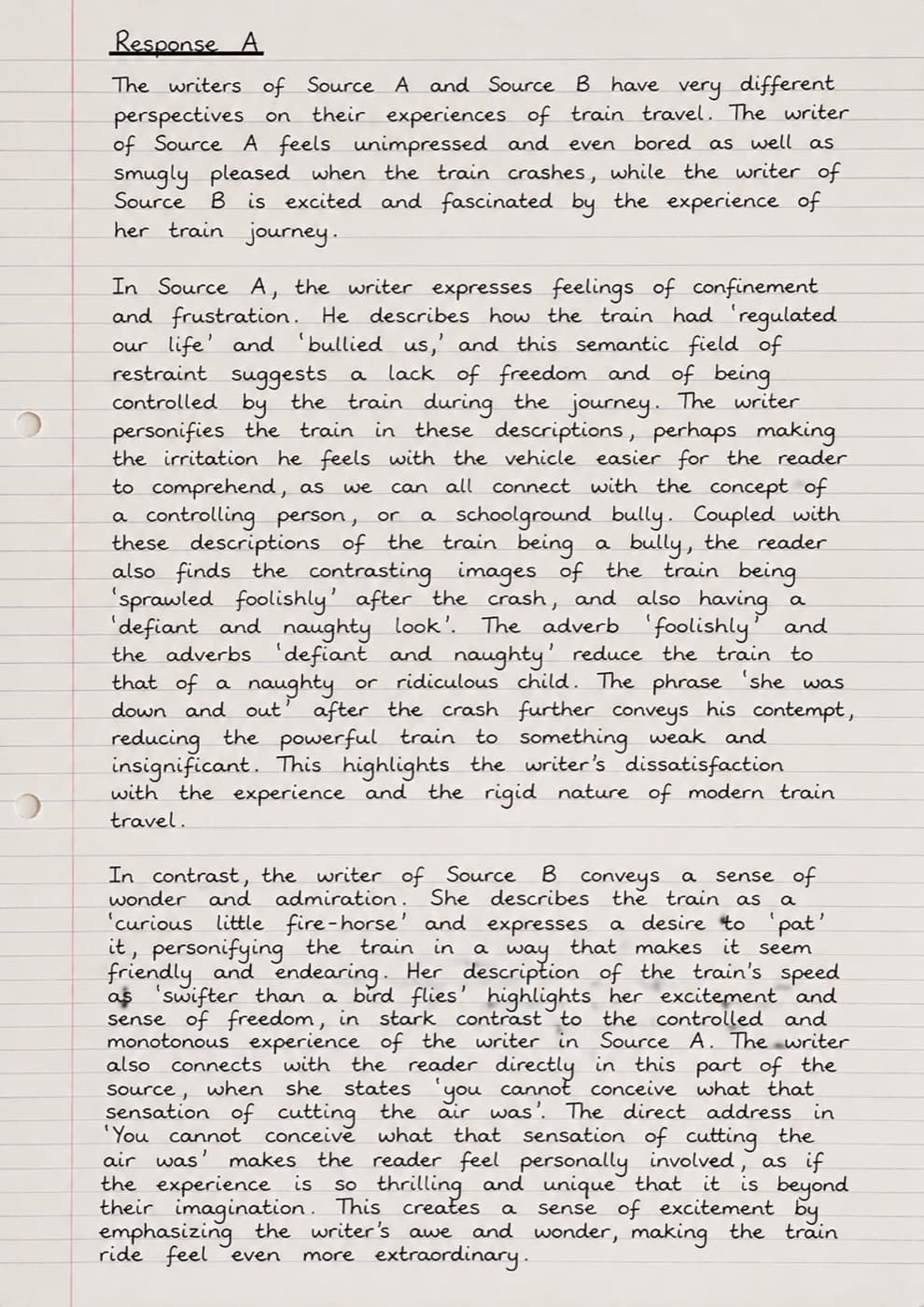
The handwriting below is from AQA’s published Answers and commentaries for GCSE English Language 8700 Paper 2: Writers' viewpoints and perspectives (from 2026) — so you can see the full loop on a public collection, not a pupil’s book.
Paper
Question
1. Upload the answer
Photograph the work, pick paper and question
Handwritten pages are read as they are — no typing required. The paper and question set the mark scheme and assessment objectives, so the feedback is usable that afternoon.
GCSE English Language · Q4
Indicative grade 9
Compare perspectives · 94%
You compare both sources directly and repeatedly, rather than writing about them separately.
You analyse methods with relevant terminology, such as 'semantic field', 'personifies', and 'direct address'.
Link the two writers more explicitly within each paragraph — whereas, similarly, in contrast.
2. Online report
Confirm the marks, keep the AO language consistent
Marks against the question total, an indicative grade, strengths and a next step. In a school, a teacher confirms or overrides every mark before pupils see it. The same wording across a class makes department standardisation faster.
3. Compare with AQA
The same published responses, marked live
Question 4 and Question 5 sit in the Level 4 band AQA published. Question 2 was published as Level 3; we awarded 6/8, inside that published band. In school marking, a teacher has the final say.
| Question | AQA published | ReMarkAble |
|---|---|---|
Q2 · Summary comparison Response B · 8 marks | Level 3 | 6/8 Sits in the published band |
Q4 · Compare perspectives Response A · 16 marks | Level 4 | 15/16 Sits in the published band |
Q5 · Transactional writing Response A · 40 marks | Level 4 | 37/40 Sits in the published band |
ReMarkAble AI
AQA 8700 Paper 2 · Q4
Indicative grade 9
Keep a copy for books, parents and the next time this student writes. AO marks and next steps stay with the piece.
4. A record of progress
Keep the trail, not just the last essay
Each marked page stays in the history. Premium PDF for books, parents and the next time you look at this student. You can see whether the marks and the next steps are moving.
GCSE English Language · Q5
Indicative grade 9
Transactional writing · 93%
Effective rhetorical opening with 'Ladies and gentlemen - we stand at a crossroads.'
Clear paragraphing and logical progression through three convincing arguments.
Develop a more memorable closing so the argument ends with a sharper final impact.
5. Teach the remaining gap
Spend the time you save on the next draft
On this Question 5 speech the remaining gap was a sharper closing. On Question 4 it was linking the two writers inside each paragraph. The time you save on marking goes into teaching that next step — across a class, not one book at a time.
The same loop, on writing you already know
These three responses appear in AQA’s published answers and commentaries. We uploaded the handwriting to the live product — Q4 awarded 15/16 — so you can see upload, report and comparison without putting a pupil’s work on a public page.
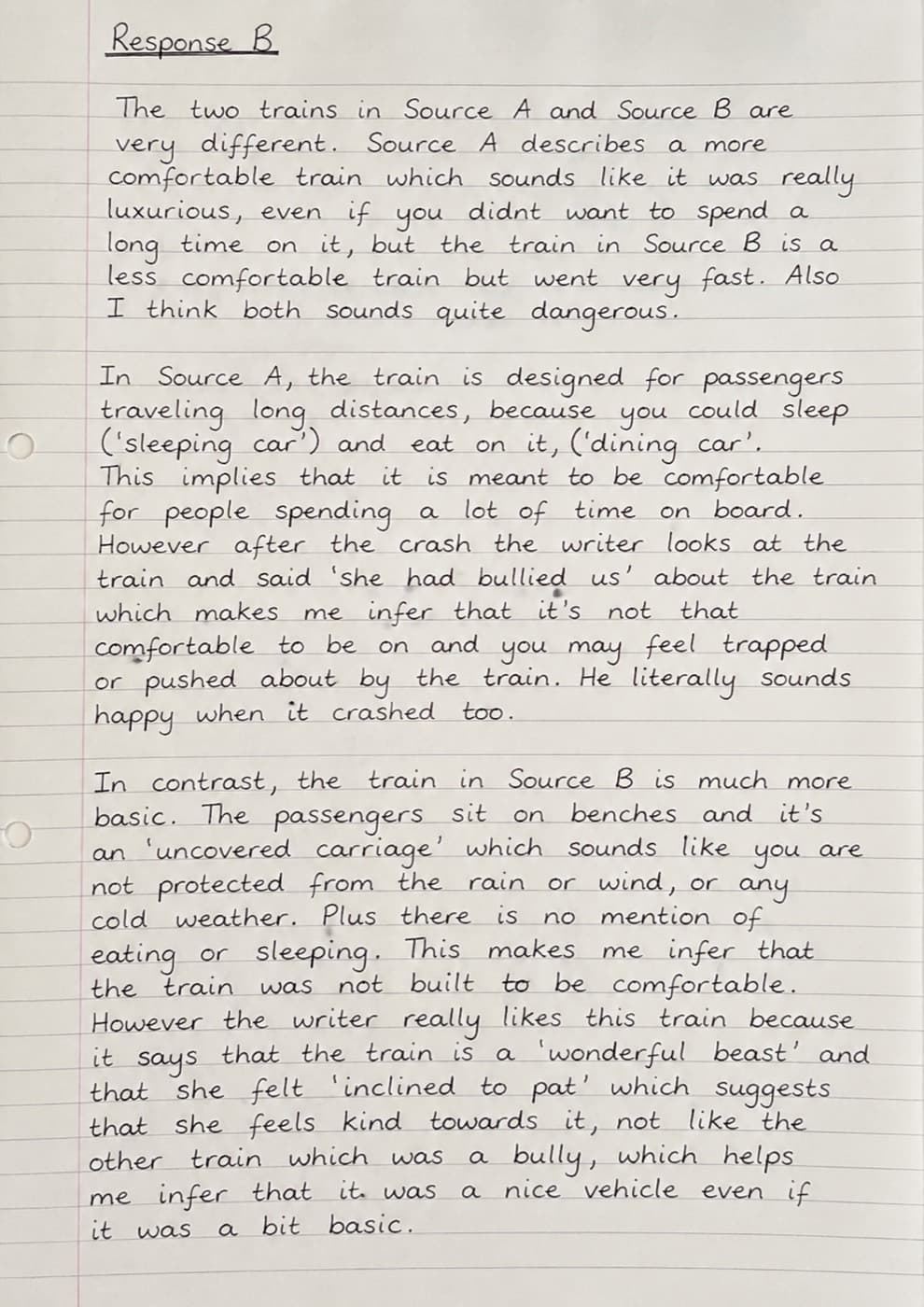
Q2 · Summary comparison · AQA Level 3
GCSE English Language · Q2
Indicative grade 7
Summary comparison · 75%
You compare the sources directly rather than writing about them separately.
You make clear inferences from detail such as ‘sleeping car’ and ‘uncovered carriage’.
Keep each inference tightly linked to the evidence; avoid speculative comment.
Q4 · Compare perspectives · AQA Level 4
GCSE English Language · Q4
Indicative grade 9
Compare perspectives · 94%
You compare both sources directly and repeatedly, rather than writing about them separately.
You analyse methods with relevant terminology, such as 'semantic field', 'personifies', and 'direct address'.
Link the two writers more explicitly within each paragraph — whereas, similarly, in contrast.
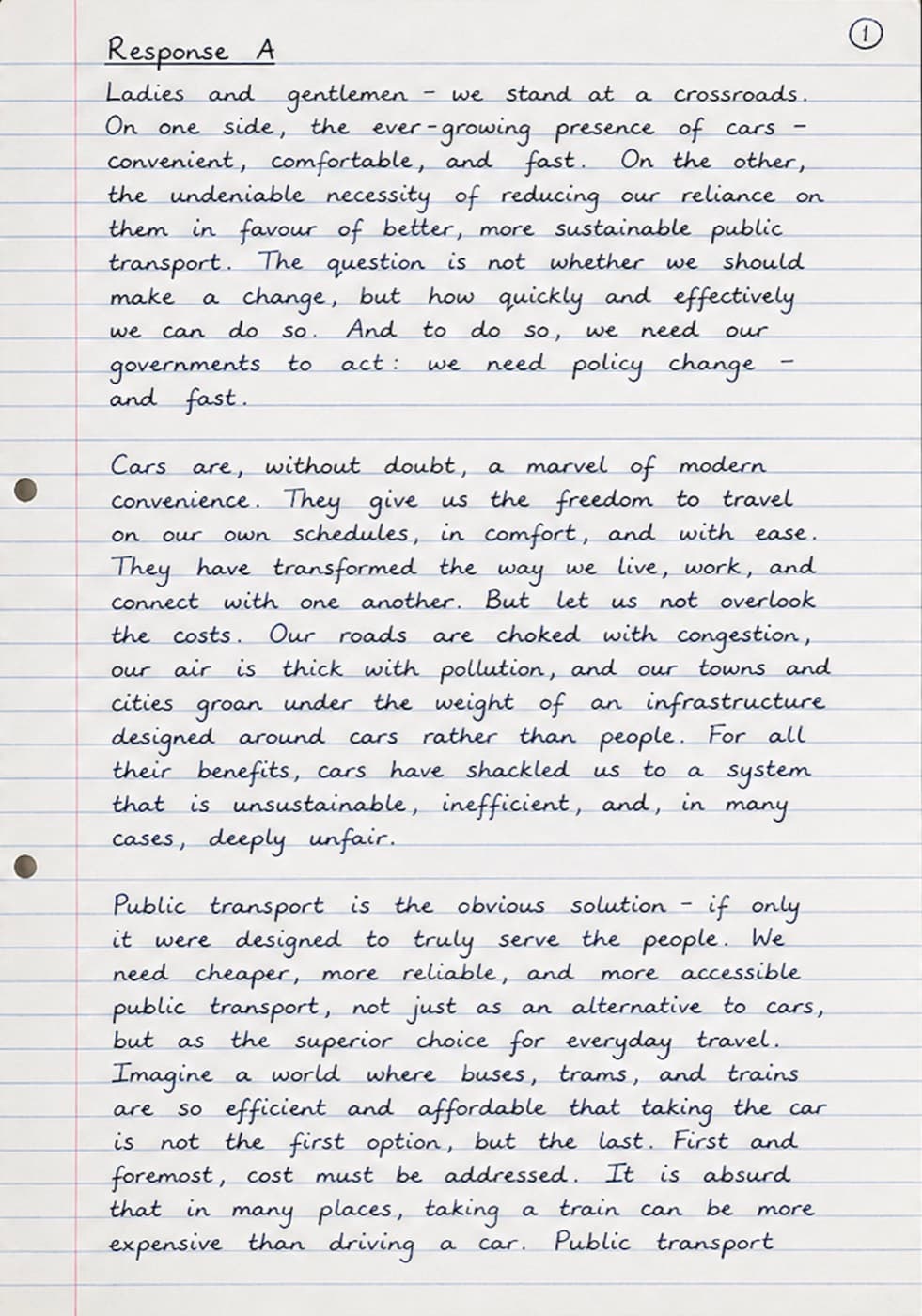
Q5 · Transactional writing · AQA Level 4
GCSE English Language · Q5
Indicative grade 9
Transactional writing · 93%
Effective rhetorical opening with 'Ladies and gentlemen - we stand at a crossroads.'
Clear paragraphing and logical progression through three convincing arguments.
Develop a more memorable closing so the argument ends with a sharper final impact.
Handwritten responses and published levels are from AQA GCSE English Language (8700) Paper 2 Answers and commentaries (from 2026, v1.1 June 2025). ReMarkAble AI is not affiliated with or endorsed by AQA. Shown so departments can compare live marks with published exemplification, not a pupil’s book. See a live marked example.
You Don't Need to Be a Teacher to Support Their Exam Prep
Whether you're a parent supporting your child through GCSEs or a tutor managing a heavy workload, ReMarkAble AI gives you feedback marked against the exam board's mark scheme to guide them. Upload their work, and we'll handle the mark schemes.
ReMarkAble AI supports GCSE teachers and students by providing structured, curriculum-aligned feedback on handwritten and typed practice work. Teachers use it to reduce marking workload and improve consistency. Students use it as a revision aid to understand how to improve before exams.
Marks are proposed against the mark scheme, with the evidence for each one. In class marking, a teacher confirms or overrides every mark before pupils see it.
Subjects where ReMarkAble AI is most effective at GCSE
ReMarkAble AI is particularly well suited to handwriting-heavy GCSE subjects, including:
Coverage varies by subject and exam board. As well as AQA, Edexcel, OCR and Eduqas, we mark WJEC GCSE for Wales (graded A*–G), CCEA GCSE English Language writing tasks and English Literature, and Pearson Edexcel International GCSE English Language A and B, English Literature and Geography.
Browse by Subject
Get subject-specific AI feedback aligned to exam board mark schemes:
AQA English Language
Get instant, AQA-aligned feedback on GCSE English Language essays. AI marking for Paper 1 and Paper 2 creative and trans...
AQA English Literature
Get instant, AQA-aligned feedback on GCSE English Literature essays. AI marking for Shakespeare, poetry anthology, prose...
AQA History
Get instant, AQA-aligned feedback on GCSE History essays and source questions. AI marking for source analysis, interpret...
AQA Business
Get instant, AQA-aligned feedback on GCSE Business responses. AI marking for case study analysis, evaluation essays, and...
AQA Geography
Get instant, AQA-aligned feedback on GCSE Geography responses. AI marking for case study essays, data response questions...
AQA Sociology
Get instant, AQA-aligned feedback on GCSE Sociology responses. AI marking for theory application, evaluation essays, and...
AQA Psychology
Get instant, AQA-aligned feedback on GCSE Psychology responses. AI marking for key study evaluation, application questio...
AQA Religious Studies
Get instant, AQA-aligned feedback on GCSE Religious Studies essays. AI marking for evaluation questions, source of wisdo...
AQA Citizenship
Get instant, AQA-aligned feedback on GCSE Citizenship responses. AI marking for evaluation essays, source analysis, and ...
AQA Science (Extended Writing)
Get instant, AQA-aligned feedback on GCSE Science 6-mark extended writing questions. AI marking for AQA GCSE Biology and...
OCR English Language
Get instant, OCR-aligned feedback on GCSE English Language responses. AI marking for non-fiction reading, rhetorical wri...
OCR English Literature
Get instant, OCR-aligned feedback on GCSE English Literature essays. AI marking for modern and literary heritage texts, ...
OCR History
Get instant, OCR-aligned feedback on GCSE History responses. AI marking for thematic studies, British depth studies, and...
OCR Geography
Get instant, OCR-aligned feedback on GCSE Geography B responses. AI marking for Our Natural World, People and Society, a...
Edexcel English Language
Get instant, Edexcel-aligned feedback on GCSE English Language essays. AI marking for imaginative writing and transactio...
Edexcel English Literature
Get instant, Edexcel-aligned feedback on GCSE English Literature essays. AI marking for Shakespeare, post-1914 texts, 19...
Edexcel History
Get instant, Edexcel-aligned feedback on GCSE History essays and source questions. AI marking for Paper 1, 2, and 3 — th...
Eduqas (WJEC) English Language
Get instant, Eduqas-aligned feedback on GCSE English Language. AI marking for Component 1 (Creative Prose) and Component...
Eduqas (WJEC) English Literature
Get instant, Eduqas-aligned feedback on GCSE English Literature essays. AI marking for Shakespeare, poetry, post-1914 pr...
Eduqas (WJEC) History
Get instant, Eduqas-aligned feedback on GCSE History essays and source questions. Covers describe, explain, and evaluati...
Built Around GCSE Assessment Expectations
Feedback is structured around common GCSE priorities:
It proposes marks and a predicted grade against the mark scheme. In class marking, a teacher confirms or overrides them before a pupil sees anything.
How Teachers Use ReMarkAble AI for GCSE
Teachers use ReMarkAble AI to:
In class marking, the teacher reviews every result, can override any mark or comment, and releases results to the class when they are ready.
How Students Use It as a Revision Aid
Students can use ReMarkAble AI on practice work to:
Feedback explains how to improve, not what to write.
Ethical, Exam-Safe Design
ReMarkAble AI is built to support learning responsibly:
This ensures the tool supports genuine understanding and exam integrity.
Works with Real Classroom Work
Who This Is For
GCSE FAQs
Related Resources
How AI Marking Works for GCSE Past Papers
Discover how AI delivers instant, criterion-based feedback.
What Grade Would You Get?
Try our AI essay checker and get an instant grade estimate.
A Level AI Marker
Explore AI-assisted feedback for A Level subjects.
Mark Handwritten Work with AI
Learn how we turn handwritten work into actionable feedback.
Better feedback across subjects — without more marking hours
Support GCSE learning with responsible, teacher-led AI.